Disclosure: We may earn a commission when you purchase through links on our site. This does not influence our reviews or recommendations.
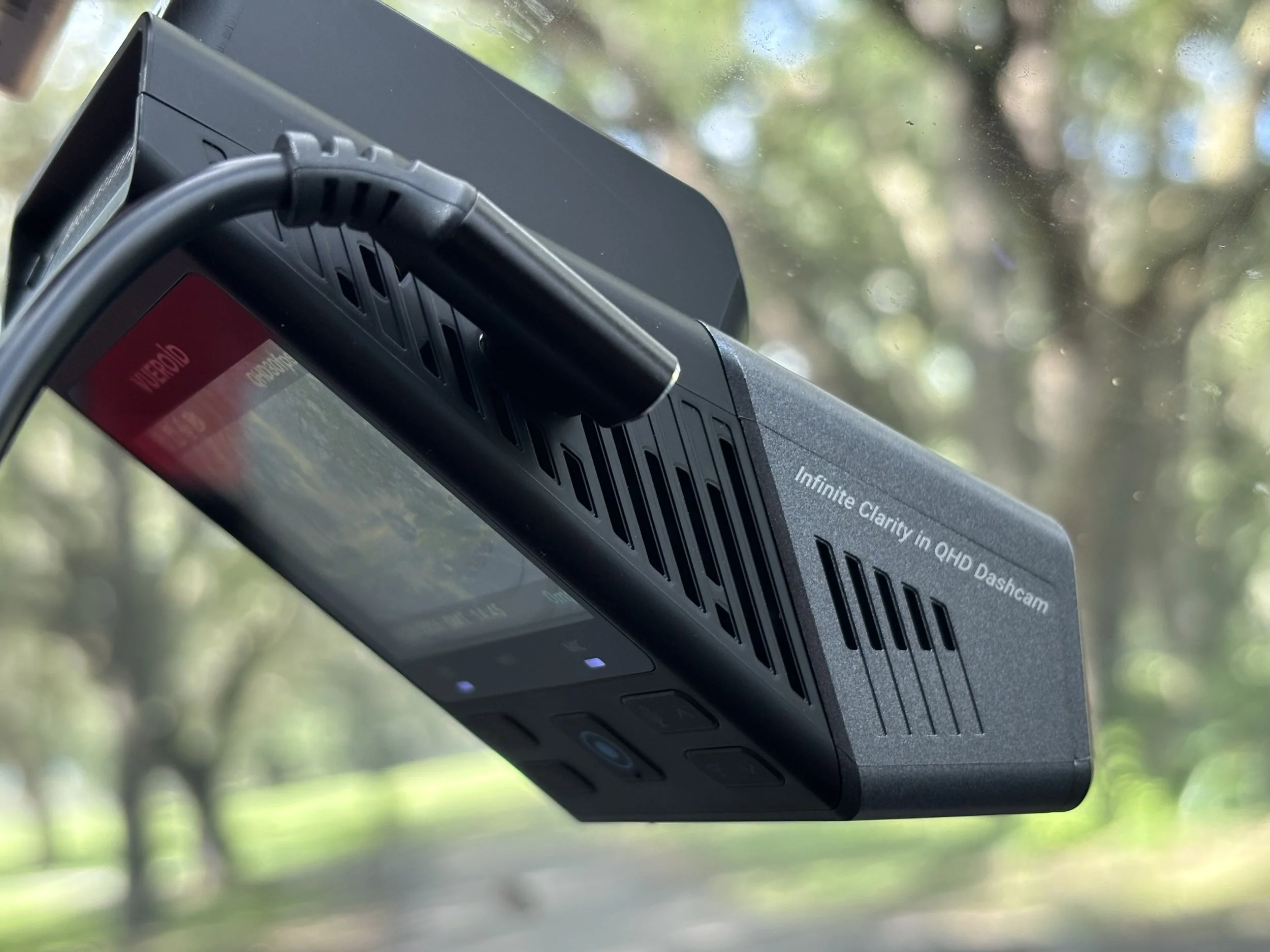
I've spent the last several weeks running the VUEROID S1 QHD Infinite as my daily dash cam, mounted in my GMC 2500. After putting it through regular commuting, highway driving, and a fair amount of off-road use (I offroad a ton!), I've got a clear picture of where this camera shines and where it falls short. Short version: the hardware is some of the best I've used, but the software experience holds it back from being an easy top pick.
Here's the full breakdown.
First Impressions and Design
Out of the box, the S1 QHD Infinite immediately feels different from most of the dash cams I've tested. A lot of cameras in this price range hang several inches down from the windshield, jut out awkwardly, or look like a point-and-shoot camera someone zip-tied behind the mirror. The VUEROID doesn't do that.
It mounts high and tight against the glass, sits compactly near the rearview mirror, and the wiring routes cleanly along the headliner. Once installed, it basically disappears from view while driving. That matters more than people think — a dash cam lives permanently in your line of sight, and one that constantly draws your eye is a daily annoyance, no matter how good the footage is.
The build quality backs this up. The housing feels solid, the buttons have a satisfying click instead of the mushy feel you get on cheaper units, and the mounting hardware doesn't feel like it'll rattle loose over time. Nothing about it feels like a generic marketplace dash cam with a new logo slapped on it.
Hardware and Specs
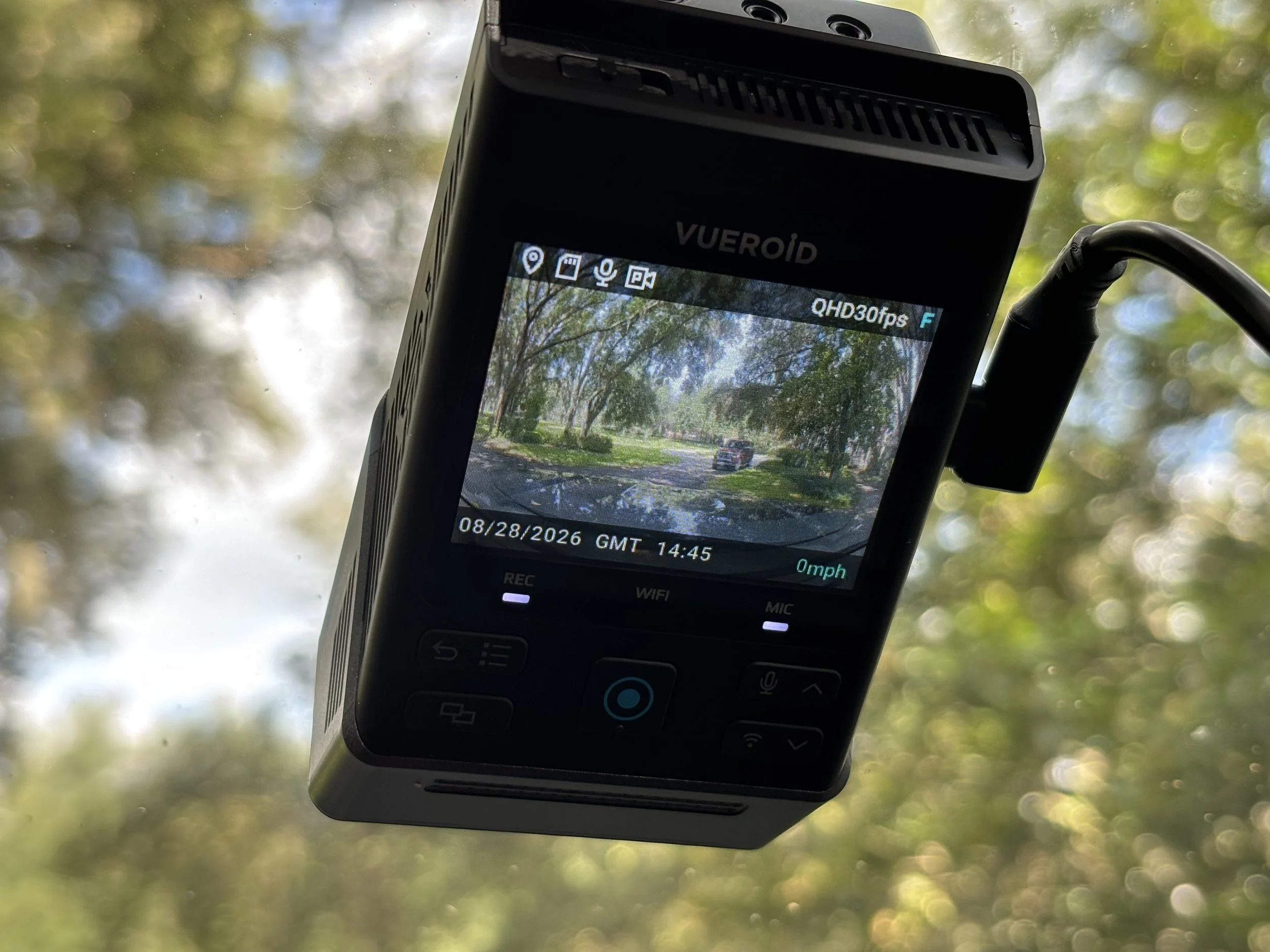
The front unit includes a 2.3-inch LCD screen, built-in GPS, and built-in Wi-Fi. Both the front and rear cameras use Sony STARVIS 2 IMX675 sensors, recording at 2560 x 1440 (QHD) at 30fps, with a 160-degree field of view on each camera.
Specification VUEROID S1 QHD Infinite Front Camera Sony STARVIS 2 IMX675 Rear Camera Sony STARVIS 2 IMX675 Front Resolution 2560 × 1440 @ 30fps Rear Resolution 2560 × 1440 @ 30fps Front FOV 160 degrees Rear FOV 160 degrees HDR Front and rear LCD 2.3 inches GPS Built in Wi-Fi Built in Storage microSD up to 512GB Data Transfer SD card, Hub App, PC Viewer, USB Parking Modes Low power, impact/motion, timelapse, and more
VUEROID also sells a three-channel version that adds an interior-facing camera, but the core two-camera QHD system reviewed here uses the same 1440p STARVIS 2 hardware front and rear.
Video Quality
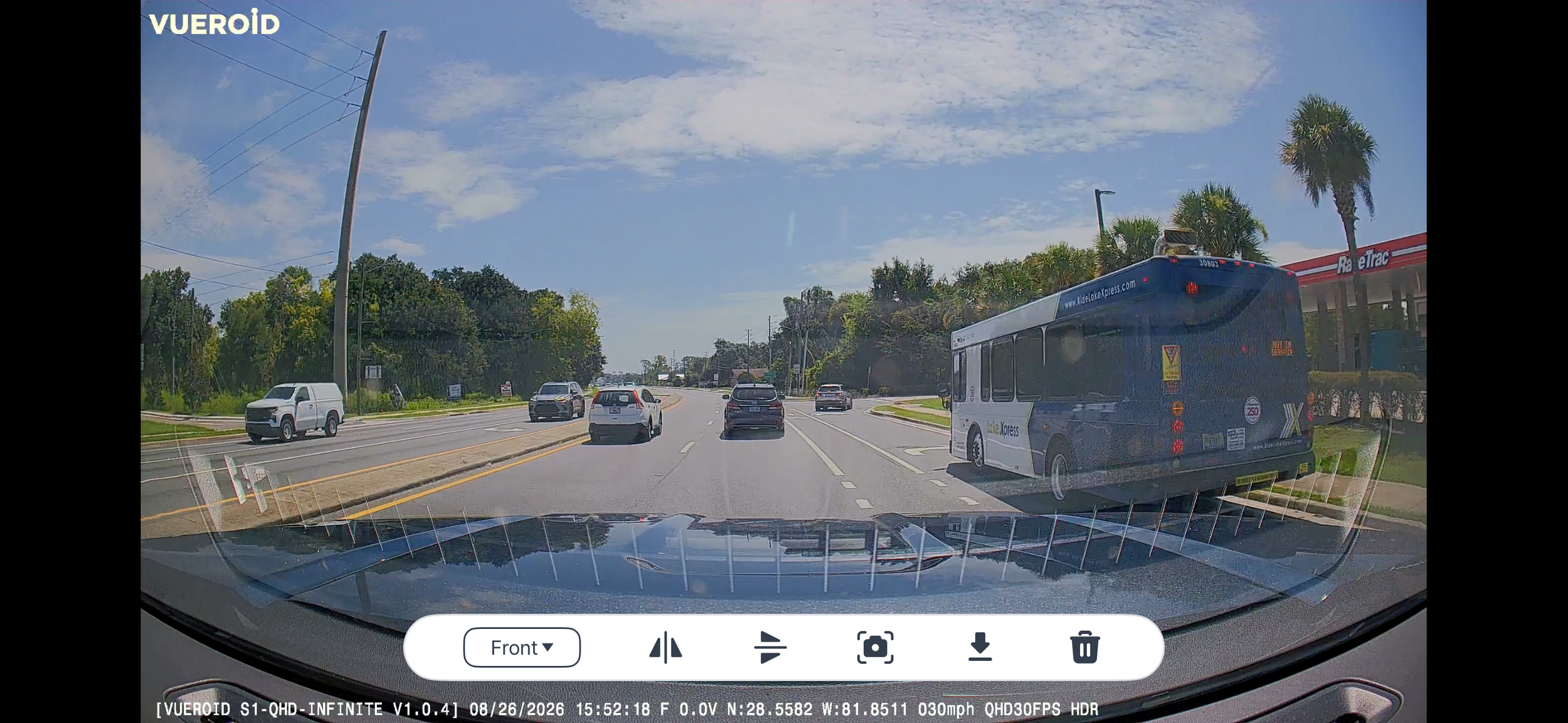
Video quality has been a genuine strength. QHD resolution gives enough detail to make out license plates, lane markings, and surrounding vehicles without generating the massive file sizes that come with 4K recording — which matters if you're filling up a microSD card daily. HDR on both cameras helps with glare going into the sun and headlight blowout at night, two situations where a lot of budget dash cams fall apart.
The camera also has an Infinite Plate Capture mode on the front unit, aimed at pulling clearer, more legible plate captures. There's also an AI license-plate restoration feature available through the app and desktop software, though it's worth noting VUEROID itself is upfront that AI recognition accuracy can vary and should be treated as a reference point rather than a guaranteed identification — not something I'd rely on for anything legal.
For day-to-day use, though, the core footage quality is what actually matters, and this camera delivers clear, usable video whether I'm on the highway or crawling through a parking lot.
The Impact Detection Problem
This is where things start to go sideways, and it's directly tied to what I drive. So it might just be me.
A GMC 2500 is a heavy-duty truck. It doesn't ride like a crossover, and I regularly take it on rougher roads and light off-road terrain. The S1's impact detection does not handle that well at all.
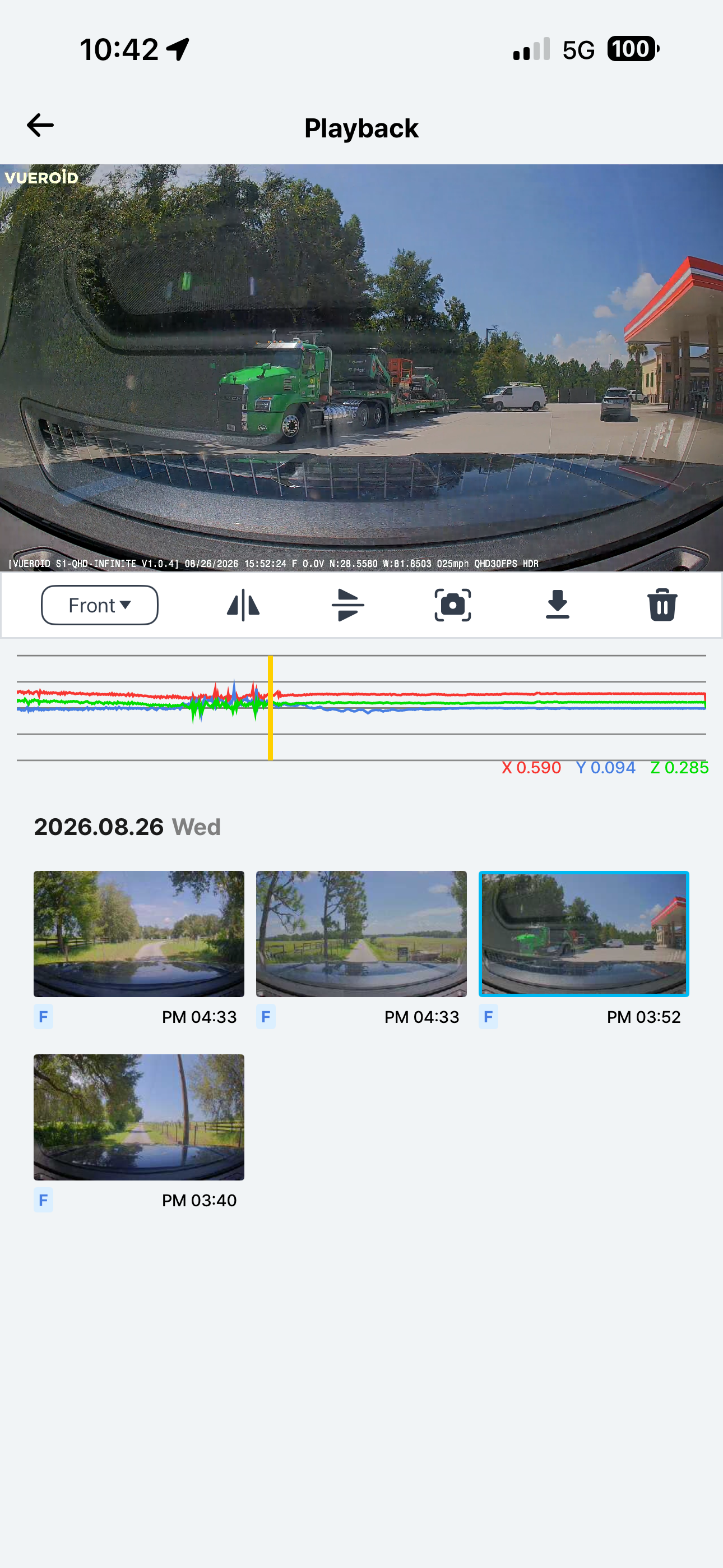
Hit a small pothole — event triggered, "accident" saved. Drive across a stretch of washboard dirt road (like my ¼ mile driveway) — another event saved. The first couple of times, it's almost reassuring, since it confirms the sensor is working. After the tenth false trigger in a single week, it stops being reassuring and starts being genuinely irritating.
The core issue is that the S1 seems tuned around smooth, normal road driving, which is a reasonable default for most buyers but doesn't account for trucks, Jeeps, work vehicles, or anyone who spends real time off pavement. A rough suspension bouncing over uneven terrain reads to the sensor a lot like an actual collision.
To be fair, this isn't a defect — the system is doing exactly what it's designed to do: catch sudden motion and lock that footage down so it doesn't get overwritten. The problem is the threshold. There's no adjustment I've found that lets you meaningfully dial sensitivity down for a rougher-riding vehicle, and there really should be. A soft-riding sedan and a loaded heavy-duty truck should not be treated identically by the same default setting.
If your vehicle rides smooth and stays on pavement, this may be a non-issue. If you drive anything with stiffer suspension or spend time off-road, budget for some annoyance here.
The App Is the Biggest Letdown
If the impact detection is a mild frustration, the app is my actual biggest complaint with this camera.
It's slow. Not "slightly slower than I'd like" slow — genuinely slow. Connecting to the camera's Wi-Fi, browsing to find the clip I want, and getting it downloaded onto my phone takes noticeably longer with the VUEROID Hub app than with any other dash cam app I've used in years of testing these things. Just to pull the photos for this review took over 5 min, the majority of other cameras I test take under 2min. Now imagine your in a wreak and need to pull footage? Not gonna be fun.
VUEROID advertises Wi-Fi 5.0 connectivity and markets the S1's app experience as faster and smoother than previous versions, with built-in clip editing and sharing. In practice, that hasn't matched what I've experienced. If I'm standing on the side of the road after something happens and I need a clip quickly — to send to insurance, to show a police officer, whatever — the app is the last thing I want to be waiting on. That's supposed to be one of the fastest, most frictionless parts of owning a dash cam, and here it isn't.
The one saving grace: you're not locked into the app. The S1 supports microSD cards up to 512GB, plus SD-card transfer, a desktop PC Viewer, and USB mode. If I need a larger batch of footage, I just pull the card and skip the app entirely. That workaround keeps the slow wireless transfer from being a total dealbreaker, but it doesn't excuse it either — a camera this well-built deserves an app that matches it.
Parking Mode and Extra Features
Parking mode on the S1 is more robust than what you get on a lot of budget-to-midrange dash cams. VUEROID includes an Extreme Low Power Mode, impact-and-motion recording, impact-and-timelapse recording, automatic recording-off zones, and its Durashift Parking Mode, along with an included hardwire cable for a proper install.
If you're buying this camera as much for parked-car protection as for driving footage — hit-and-runs, break-ins, that kind of thing — this is a real strength. Built-in GPS also logs location and speed alongside your footage, which is useful if you ever need to reconstruct exactly what happened during an incident.
How It Compares to Other Dash Cams
After testing a range of dash cams over the years — from budget units to more established names like RedTiger, Nextbase, Viofo, and Thinkware — here's roughly where the S1 QHD Infinite lands:
Design and build quality: This is where the VUEROID pulls ahead of most of the field. A lot of well-known dash cams still use bulkier housings that hang down from the windshield or feel like an obvious aftermarket add-on. The S1's low-profile, high-mount design is genuinely one of the cleanest installs I've dealt with, on par with — or better than — cameras costing noticeably more.
Video quality: Competitive with other QHD-class cameras I've tested. It's not doing anything revolutionary compared to other Sony STARVIS-based sensors on the market, but it holds its own, and the HDR performance is a real plus over cheaper cameras that wash out in bright or backlit conditions.
Impact detection tuning: This is a spot where more established brands tend to do better. Several other cameras I've used offer more granular sensitivity adjustment, letting you back off the trigger threshold for trucks or rougher-riding vehicles. The S1 doesn't give you that same level of control, and it shows the moment you leave smooth pavement.
App and transfer speed: This is the S1's clearest weak point relative to the competition. Other dash cam apps I've used — even some from smaller, less established brands — get you from "connect to Wi-Fi" to "clip saved on phone" noticeably faster. The gap here isn't small; it's the single biggest difference between the VUEROID experience and using something like a Nextbase or Viofo unit day-to-day.
Parking mode features: Comparable to what you'd expect from a higher-end dash cam. VUEROID isn't cutting corners here — the feature set is on par with more expensive, more established competitors.
Overall value: If you're prioritizing physical design, build quality, and a clean install, the S1 QHD Infinite is hard to beat in its price range. If fast, reliable app-based clip retrieval and adjustable impact sensitivity for a rougher vehicle matter more to you, some of the more established brands still have an edge.
Who Should Buy This
The S1 QHD Infinite makes the most sense if you care about a clean, unobtrusive install and don't mind pulling the SD card instead of relying on the app. It's a great fit for daily drivers, commuters, and anyone who wants a dash cam that looks like it belongs in the vehicle instead of bolted onto it.
I'd think twice if your vehicle rides rough or you spend meaningful time off-road — the impact alerts will wear on you. And if quick, on-the-spot clip access through your phone is a core part of how you plan to use a dash cam, the slow app is going to be a real point of friction.
Final Thoughts
The VUEROID S1 QHD Infinite is a genuinely impressive piece of hardware. The design is compact and clean, the build quality is excellent, and the video quality holds up well against other cameras in its class. It's easily one of my favorite dash cams from a pure physical-design standpoint.
But the software side needs work. The impact sensor is too aggressive for my GMC 2500, especially off-road or over rough terrain, and the app's clip-transfer speed is by far my biggest complaint after weeks of daily use. Compared to other dash cams I've tested, getting footage off this camera and onto my phone takes far too long.
That creates a bit of a split personality: a premium-feeling dash cam while you're driving, and a noticeably less polished one the moment you need to actually interact with it.
If VUEROID tightens up the app speed and gives owners real control over impact sensitivity, this becomes an easy recommendation. As it stands, I still like it a lot — mostly because the hardware and design are that good.