DJI Osmo Action 4 vs. GoPro & Insta360: One-Year Long-Term Review
Disclosure: We may earn a commission when you purchase through links on our site. This does not influence our reviews or recommendations.
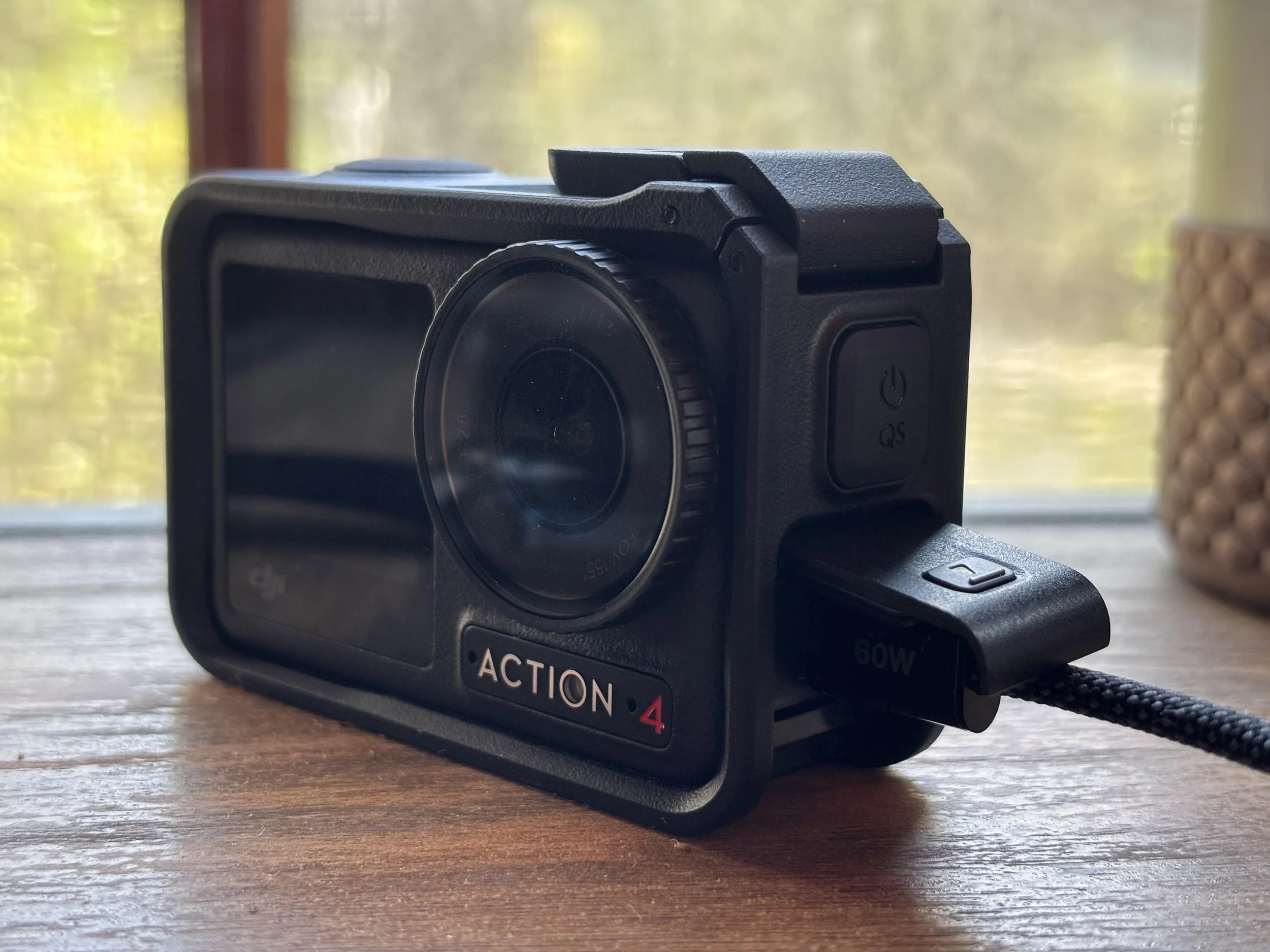
I bought the DJI Osmo Action 4 for one simple reason: I wanted an action camera that would just work. Simple, easy to use, work.
I've never been a GoPro guy. I've had my own issues with them over the years, and I've watched enough friends deal with random glitches, freezes, battery problems, and general frustration that I finally decided to try something else. I did a bunch of research — including using ChatGPT to help me narrow down the options — and landed on the DJI Osmo Action 4. A year later, I'm glad I did.
I'm not going to turn this into a spec sheet breakdown, because that's not how I actually use this camera. I bought it for basic 1080p video, underwater recording, easy file transfers, removable batteries, and microSD storage. That's it. And for that kind of use, the Action 4 has been excellent.
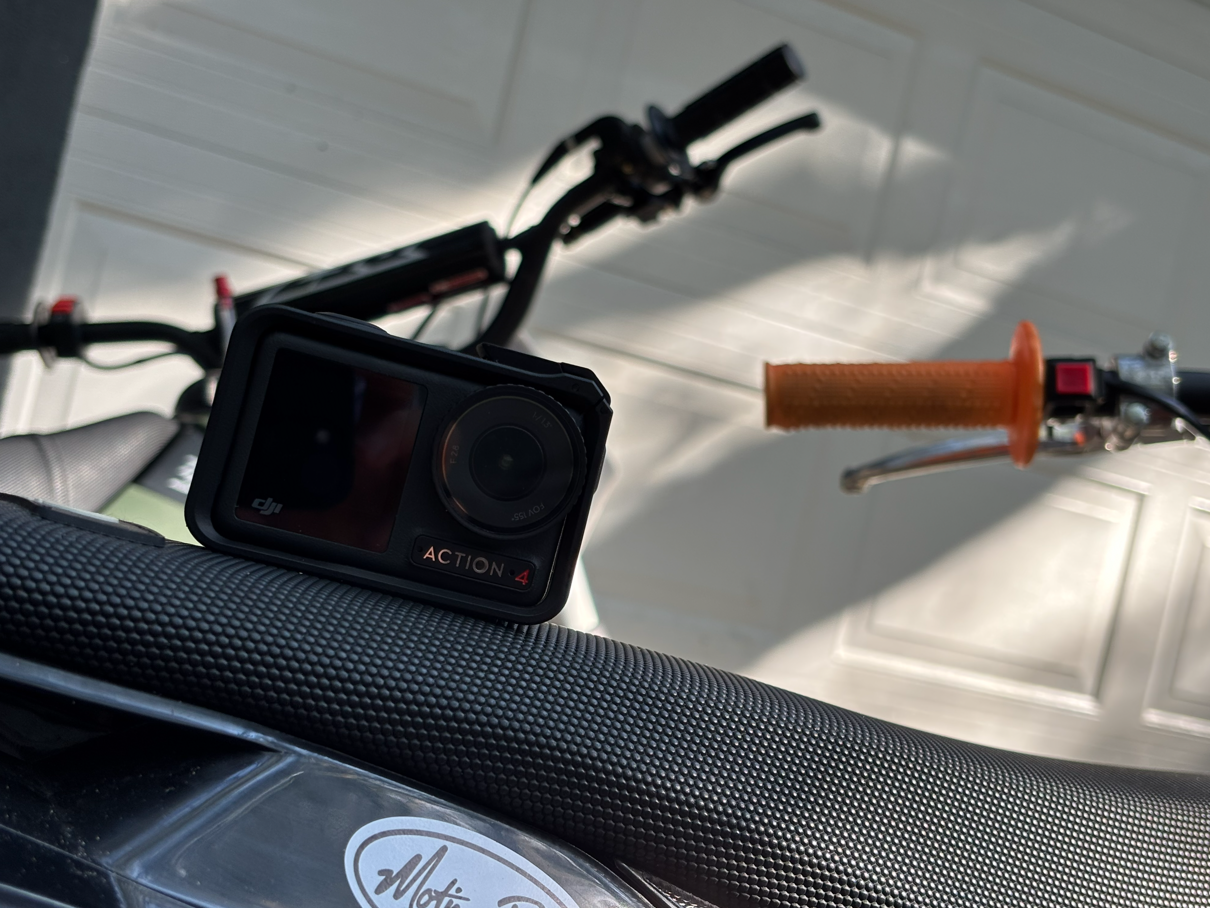
One Year Later, It's Still Easy to Use
The biggest compliment I can give the Action 4 is that I don't really have to think about it. That matters more to me than another page of specs.
I still shoot a lot of YouTube footage on my iPhone, because an iPhone is stupidly convenient — pull it out, hit record, AirDrop the file, done. No dedicated camera is going to beat that for pure simplicity.
But there are plenty of situations where I don't want to use my phone, and that's exactly where the Action 4 has earned its spot. If I'm around water, mounting a camera somewhere sketchy, shooting something where the camera might get dirty, or I just want a dedicated device with removable storage and batteries, I grab the DJI. It's become the camera I use when I don't want to worry about the camera.
The Front Screen Is Still Fantastic
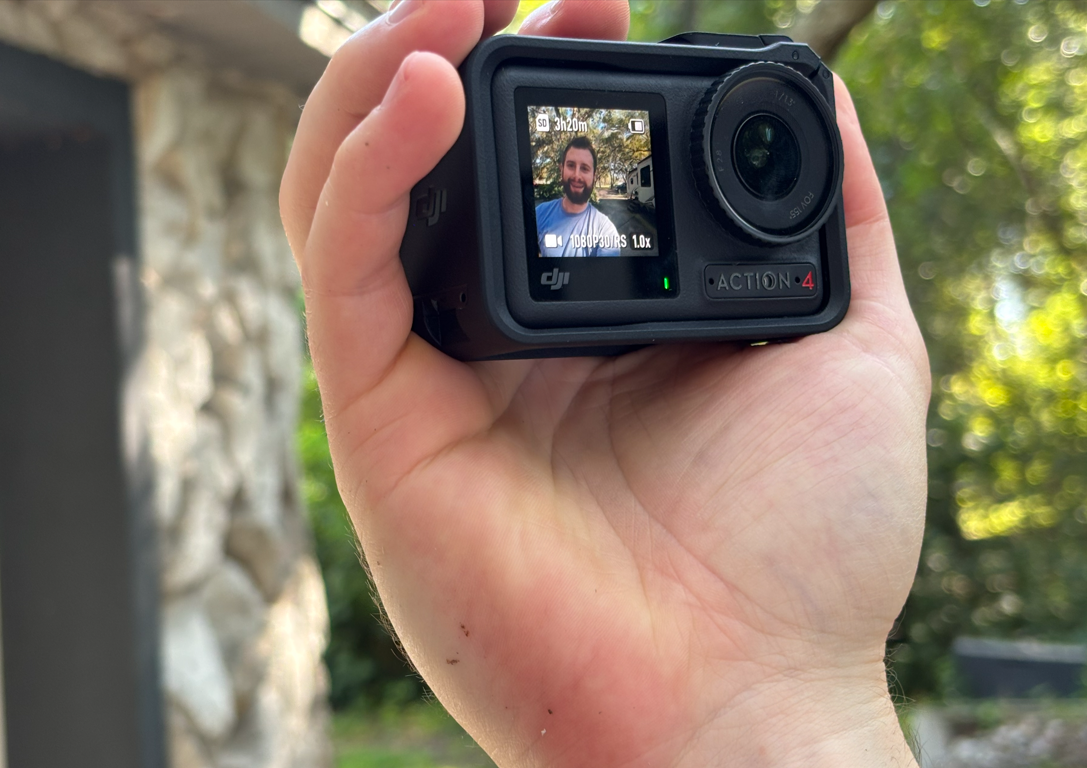
One of my favorite features is still the front-facing display. Sounds minor until you start filming yourself regularly.
When I'm holding the Action 4 out in front of me for a YouTube segment, I can actually see my framing instead of guessing whether I'm centered or whether half my head got cut out of the shot. Both the front and rear displays are touchscreens — 1.4 inches up front, 2.25 inches on the back. For selfie-style video, walkthroughs, or quick commentary where I'm both the camera operator and the person on camera, that front screen is genuinely useful. I wouldn't want to go back to a camera without one.
Worth noting: this is one area where the competition has caught up or pulled ahead. Insta360's Ace Pro series uses a flip-up screen instead of a fixed front display, which actually gives you more flexibility — you can angle it for low mounts, like on a bike, not just point-blank selfie shots. It's a fair trade-off: DJI's screen is always there and simple, Insta360's is more versatile but adds a moving part that could eventually wear out. GoPro's Hero13 Black, meanwhile, still runs dual LCDs, and only the rear one is touch-sensitive — so if you're comparing front screens specifically, DJI and Insta360 are both ahead of GoPro there.
I've Used It Underwater Constantly
This is probably the biggest real-world test mine has been through. I regularly shoot robotic pool cleaner videos, so the Action 4 has spent a ton of time underwater — not once or twice for a review, a lot — and it's been completely reliable.
DJI rates the Action 4 as waterproof to 18 meters without a case, or up to 60 meters with the optional waterproof housing. For the pool work I'm doing, that's way more than I actually need. I drop it in, get the shot, pull it out, rinse it off, and move on.
That reliability is exactly why I wanted a dedicated action camera instead of risking an expensive phone around water every time. And it's also where DJI has genuinely separated itself from GoPro. The Hero13 Black caps out lower without a housing, so if you're someone who's constantly in or around water without wanting to deal with an extra case, that's a real point in DJI's favor.
Removable Batteries Are Still a Huge Advantage
Phones have gotten really good as cameras, but dedicated cameras still hold onto some advantages that are hard to replace. Removable batteries are one of them.
If I run the Action 4 down during a long day of filming, I don't have to stop and let the whole camera charge. I swap in another battery and keep going. DJI rates the standard battery at 1,770mAh with up to 160 minutes of runtime under its own 1080p test conditions — real-world time depends a lot on resolution, stabilization, screen usage, and temperature, but the point for me is that I can swap batteries at all.
That flexibility is still a big reason I'd pick a dedicated action camera over a phone for anything longer than a quick clip.
MicroSD Storage Makes File Management Easy
Same story with the memory card. The Action 4 takes microSD storage up to 512GB, and for my workflow that's great. I shoot what I need, pull the card, stick it in my computer, and start working with the files directly. No cloud syncing, no wireless transfer, no digging through a giant camera roll on my phone before I can edit.
Record. Remove card. Copy files. Done. There are faster, fancier workflows out there, but sometimes the old-school way is still the easiest.
1080p Is Still Plenty for What I Do
The Action 4 can shoot up to 4K/120fps off its 1/1.3-inch sensor, which is genuinely solid hardware. But I mostly shoot 1080p, and that's kind of the whole point of this review.
Tech reviews get obsessed with using every feature just because it exists. I don't need 4K/120 every time I drop a camera in a swimming pool. For YouTube B-roll, underwater shots, talking-to-camera segments, and basic action footage, 1080p gives me exactly what I need while keeping file sizes manageable and editing simple. Could I squeeze more image quality out of it? Sure. Do I need to most of the time? Nope.
If you are someone who wants to crop in hard in post or print stills, it's worth knowing Insta360's Ace Pro pushes a higher-megapixel sensor for exactly that kind of flexibility. That's just not what I'm doing with this camera.
I Do Wish It Had Better Zoom
If there's one thing I occasionally wish the Action 4 did better, it's zoom. DJI gives you digital zoom, up to 2x during normal recording. It works, but this obviously isn't a camera built around zooming into distant subjects.
I get why it doesn't exist, though. A real optical zoom means more complexity, more moving parts, more weight, more cost — and suddenly the small waterproof camera I like isn't small anymore. So while I occasionally want more reach, I don't count it as a real complaint. The simplicity is part of why I like the camera in the first place.
The Action 4 vs. Using My iPhone
This comparison actually matters more to me day-to-day than Action 4 vs. GoPro. I still use my iPhone constantly for video — it's already in my pocket. If I'm filming indoors, grabbing a quick product clip, or shooting something with little risk of damage, the iPhone is often still the faster option.
But the Action 4 wins as soon as conditions get more demanding:
Water? Action 4.
Mounting it somewhere? Action 4.
Risk of dropping it? Action 4.
Longer shoot where I want swappable batteries? Action 4.
Handing the camera to someone else without handing them my whole phone? Definitely Action 4.
It didn't replace my iPhone. It filled in all the gaps where I didn't want to use one.
Why I Chose DJI Instead of GoPro (or Insta360)
I didn't buy the Action 4 to join a camera ecosystem or because DJI had the biggest number on a spec sheet. I bought it because I was tired of hearing — and experiencing — stories about action cameras being frustrating when they should be simple.
For what it's worth, I get why people land on the other two brands as well. GoPro basically invented this category, and the Hero13 Black's modular lens system is genuinely appealing if you want more creative flexibility on one body. Insta360's Ace Pro line has a flip screen, AI-driven editing tools, and a more "creator-first" feel if you're the type who wants to do a lot of the editing on your phone right after you shoot.
But an action camera has one job above everything else: capture the footage when you press record. After a year, that's what I appreciate most about the Action 4. Mine has simply worked. No major reliability problems, no strange recurring failures, no moment where I've regretted picking DJI over the alternatives.
That counts for a lot more in a long-term review than whether a competing camera technically wins on a spec sheet somewhere.
DJI Osmo Action 4 Specs That Actually Matter
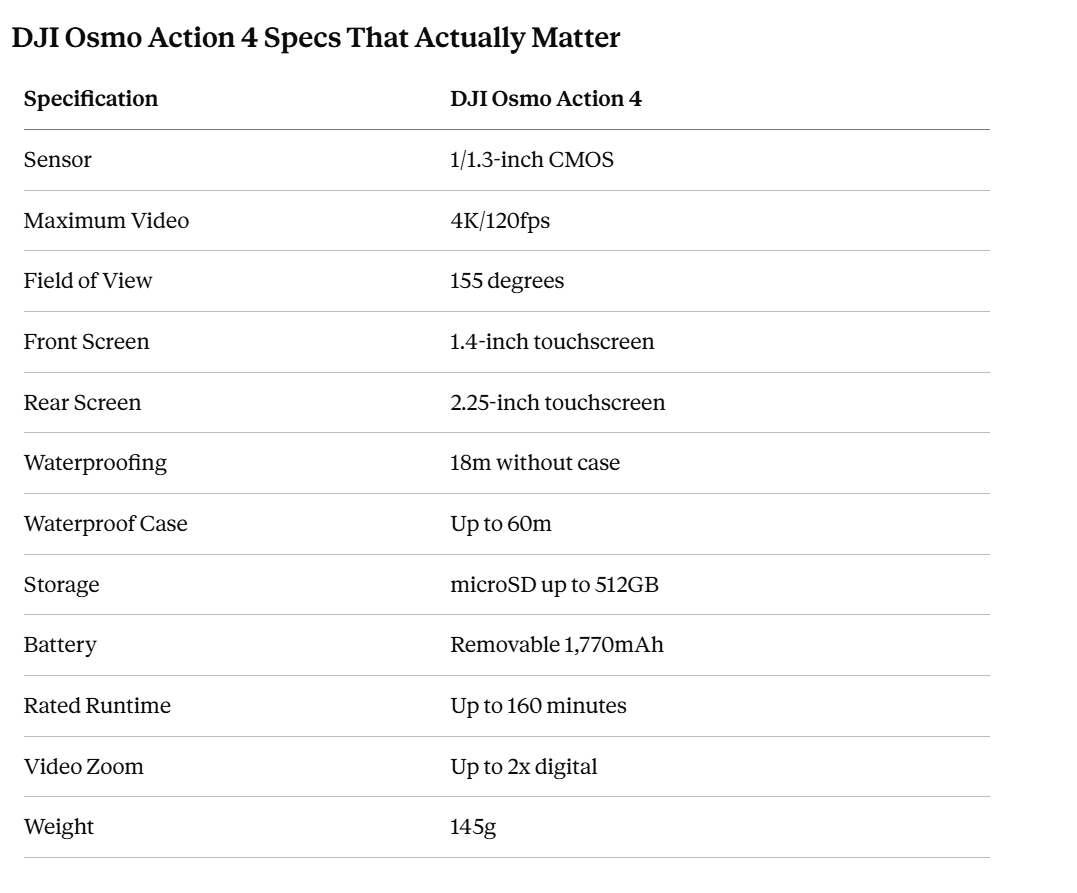
DJI's full spec sheet goes way deeper than this, but these are the numbers that have actually mattered during a year of ownership.
Is the DJI Osmo Action 4 Still Worth Buying?
For the right price, absolutely. It's not DJI's newest action camera anymore — DJI has since moved on to the Osmo Action 5 Pro — but that's actually part of why I still think it's interesting. Older flagship cameras tend to become great buys once prices drop, especially when the hardware still does everything most people realistically need. If you find the Action 4 well under its original launch price, there's a lot of value sitting there: removable batteries, microSD storage, front and rear touchscreens, strong waterproofing, solid stabilization, and more recording capability than I personally even use.
That's exactly the kind of "older tech, great deal" purchase I like making.
One-Year Verdict
After a year, I really don't have much negative to say about the DJI Osmo Action 4. It does exactly what I bought it to do.
I wanted a simple, dedicated camera for 1080p recording, underwater video, easy file transfers, removable batteries, and situations where I didn't want to risk my iPhone. The Action 4 has delivered on every part of that. I love the front-facing screen. It's spent tons of time underwater shooting pool-cleaner footage without giving me a single problem. The removable battery and microSD card are still genuinely useful, and the camera has been reliable enough that I grab it without a second thought about whether it's going to work.
Would I like a little more zoom sometimes? Sure. But I'd rather keep the small, simple form factor than turn this into a bulkier, interchangeable-lens setup. After a year of real use, that simplicity is exactly why I still reach for it.
Score: 9.5/10
The DJI Osmo Action 4 isn't the camera I use for everything. It's the camera I reach for when my phone isn't the right tool — and after a year, it's become one of the easiest pieces of video gear I own to recommend.