McIntosh CS7500 Streaming Preamplifier Brings Qobuz, Spotify, TIDAL and HDMI to Modern Hi-Fi
Disclosure: We may earn a commission when you purchase through links on our site. This does not influence our reviews or recommendations.
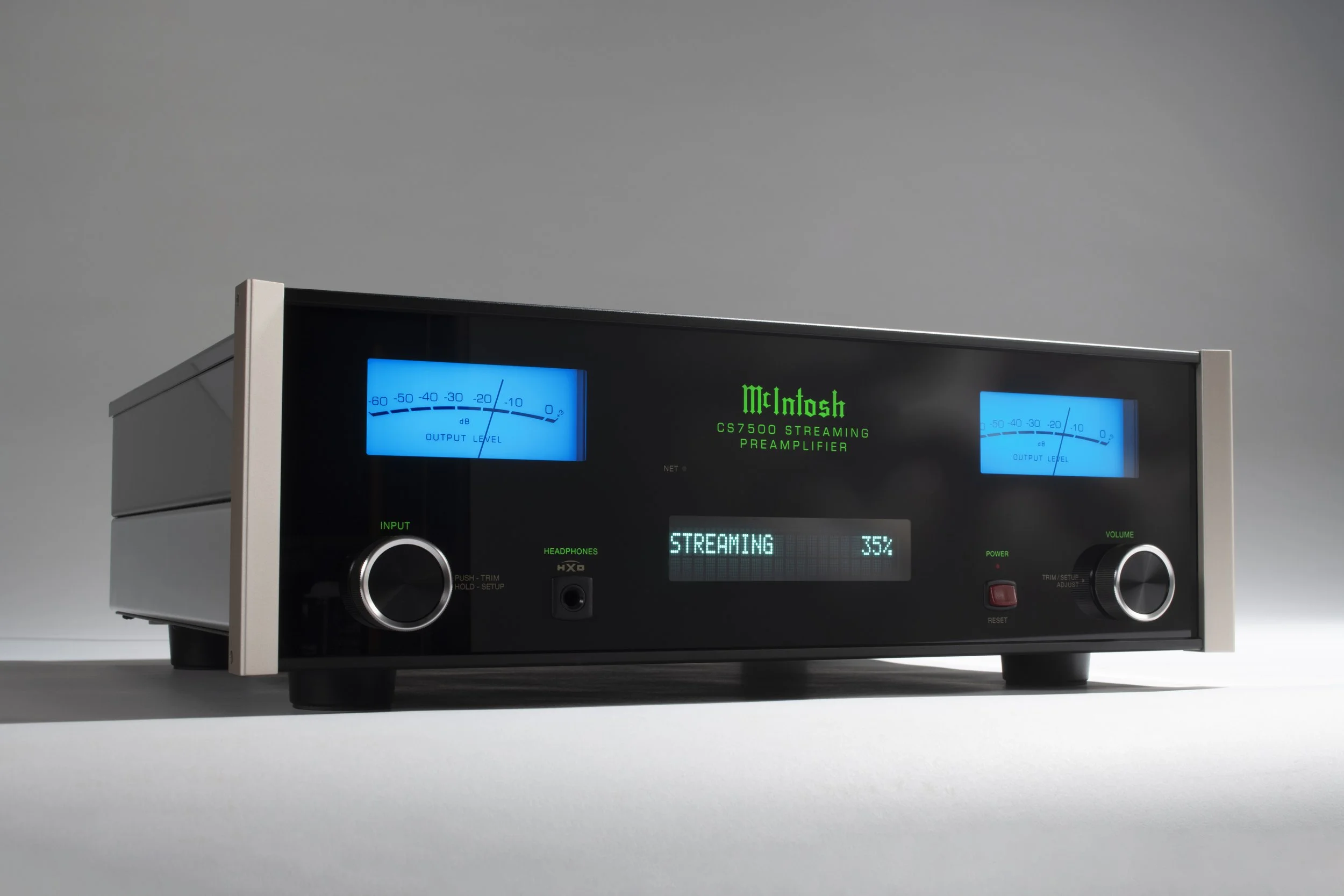
McIntosh’s new CS7500 combines a high-end preamplifier, network streamer, 32-bit DAC, phono input and HDMI ARC in one component—but I’d love to see McIntosh take this all-in-one philosophy even further. McIntosh has announced the CS7500 Streaming Preamplifier, a new all-in-one source and control component designed to bring traditional two-channel hi-fi and modern streaming together in a single chassis. Rather than requiring separate streamer, DAC and preamplifier components, the CS7500 handles all three jobs while retaining enough analog and digital connectivity to serve as the center of a fairly serious McIntosh system. Streaming support includes Qobuz Connect, Spotify Connect with Spotify Lossless and TIDAL Connect with TIDAL Max, while Apple AirPlay, Google Cast and Bluetooth cover wireless playback from phones, tablets and computers. The CS7500 is also both Roon Ready and Roon Tested.
McIntosh says the CS7500 will be available through authorized dealers beginning August 26, 2026.
Shop the best deals on Hifi Streamers on Amazon!
McIntosh Puts Streaming at the Center
The CS7500 is clearly designed around how a lot of people actually listen to music now. Qobuz Connect, Spotify Connect and TIDAL Connect are built directly into the component, allowing playback to be controlled through each service's existing app rather than forcing owners into a proprietary McIntosh streaming interface. Bluetooth is also included with support for AAC, Qualcomm aptX HD and aptX Adaptive. For someone building a modern two-channel system, that means the CS7500 can essentially become the source for most everyday listening without requiring another streamer sitting beside it.
But McIntosh hasn't abandoned physical sources.
Six Analog Inputs, Seven Digital Inputs and Phono
The CS7500 includes six analog inputs, consisting of two balanced connections, three unbalanced connections and a dedicated phono input for a turntable. There are another seven digital audio inputs, including USB, coaxial and optical connections. USB playback supports native DSD512 and DXD up to 384kHz, while coaxial and optical inputs support resolutions up to 24-bit/192kHz. At the center of the digital section is a Quad Balanced, eight-channel, 32-bit DAC. McIntosh says the implementation is designed around wide dynamic range and low distortion across digital sources.
Put everything together and the CS7500 can accommodate a pretty enormous mix of sources without requiring another preamp or DAC elsewhere in the system.
HDMI ARC Makes It Useful With a TV
One of the more important additions for modern systems is HDMI ARC. Connect a compatible television and the CS7500 can bring TV, movies, concerts and streaming video into the same two-channel system used for music. Dolby and DTS multichannel formats are converted to two-channel audio for playback. That's particularly useful for someone who wants a serious stereo system in a living room but doesn't necessarily want to build an entire surround-sound system around an AV receiver or processor.
Your television effectively becomes another source alongside a turntable, streamer, CD player or computer.
Shop the best deals on Hifi Streamers on Amazon!
Flexible Outputs for Power Amps and Subwoofers
Because the CS7500 is a preamplifier rather than an integrated amplifier, owners still choose their own power amplification. McIntosh provides two pairs of balanced and unbalanced variable outputs, along with a fixed unbalanced output. The second set of variable outputs can also be configured for a single subwoofer or stereo subwoofers, making it easier to build a 2.1- or 2.2-channel system without adding another piece of signal-management hardware. That also leaves plenty of room to scale the system. Someone could start with a relatively simple stereo power amplifier and later move into larger McIntosh amplification without replacing the CS7500 at the center of the system.
It Still Looks Like a McIntosh
Despite everything happening internally, there's basically zero chance of mistaking the CS7500 for another company's product. McIntosh's black glass front panel, illuminated logo, rotary controls and blue meters are all here. The chassis combines mirror-polished stainless steel on the lower section with a hairline-brushed black titanium stainless steel upper chassis and custom-machined brushed end caps.
It's unmistakably McIntosh, just built around a much more modern collection of sources.
Why It Matters
This is the direction I want to see more of from McIntosh, well sort of. I sold McIntosh gear for years, and you know what I sold a ton of? The company's more approachable, compact products. Something like the MA352 was incredibly easy for customers to understand. It looked like McIntosh, felt special, sounded great, and consolidated a huge portion of the system into one component.
There are absolutely customers who want a wall of McIntosh equipment, and that's always going to be part of the appeal of the brand. But there's another customer with money to spend who wants high-end audio without dedicating half a room to equipment. The CS7500 gets closer to that idea. You've got streaming, a DAC, phono, analog sources, digital sources, HDMI ARC and preamplification all living in one McIntosh component. Add a power amplifier and speakers and you've got a legitimately serious modern system without needing a giant stack of source components. But I'd love to see McIntosh go even further. Give me more compact McIntosh. Give me smaller all-in-one systems. Hell, give me proper McIntosh desktop audio. Guys who have money to spend have desks.
Imagine a genuinely compact McIntosh integrated amplifier or DAC/headphone amp designed for a high-end desktop system, complete with the black glass and tiny blue meters. There's an entire category of premium desktop audio exploding right now, and McIntosh has one of the few industrial designs that could instantly make a small desktop component feel special. The CS7500 isn't that product, but I like the philosophy behind it: take a bunch of things that previously required separate boxes and bring them together without abandoning what makes McIntosh feel like McIntosh.
I'd love to see considerably more of that.
Shop the best deals on Hifi Streamers on Amazon!
Pricing and Availability
The McIntosh CS7500 Streaming Preamplifier will be available through authorized McIntosh dealers beginning August 26, 2026. McIntosh did not include U.S. pricing in the announcement provided for this article. Dang. The CS7500 is an interesting addition because it acknowledges that even at the very high end, convenience matters. Streaming, vinyl, television audio and traditional digital sources no longer need to live in completely separate systems. And if McIntosh keeps moving toward high-end equipment that does more while taking up less space, I'm all for it.
Now give me those tiny blue meters on my desk.