ICARZONE UR1000 Review: ICARZONE Sent Me a Fix, So I Tested It Again
Disclosure: We may earn a commission when you purchase through links on our site. This does not influence our reviews or recommendations.
Setup and Hardware
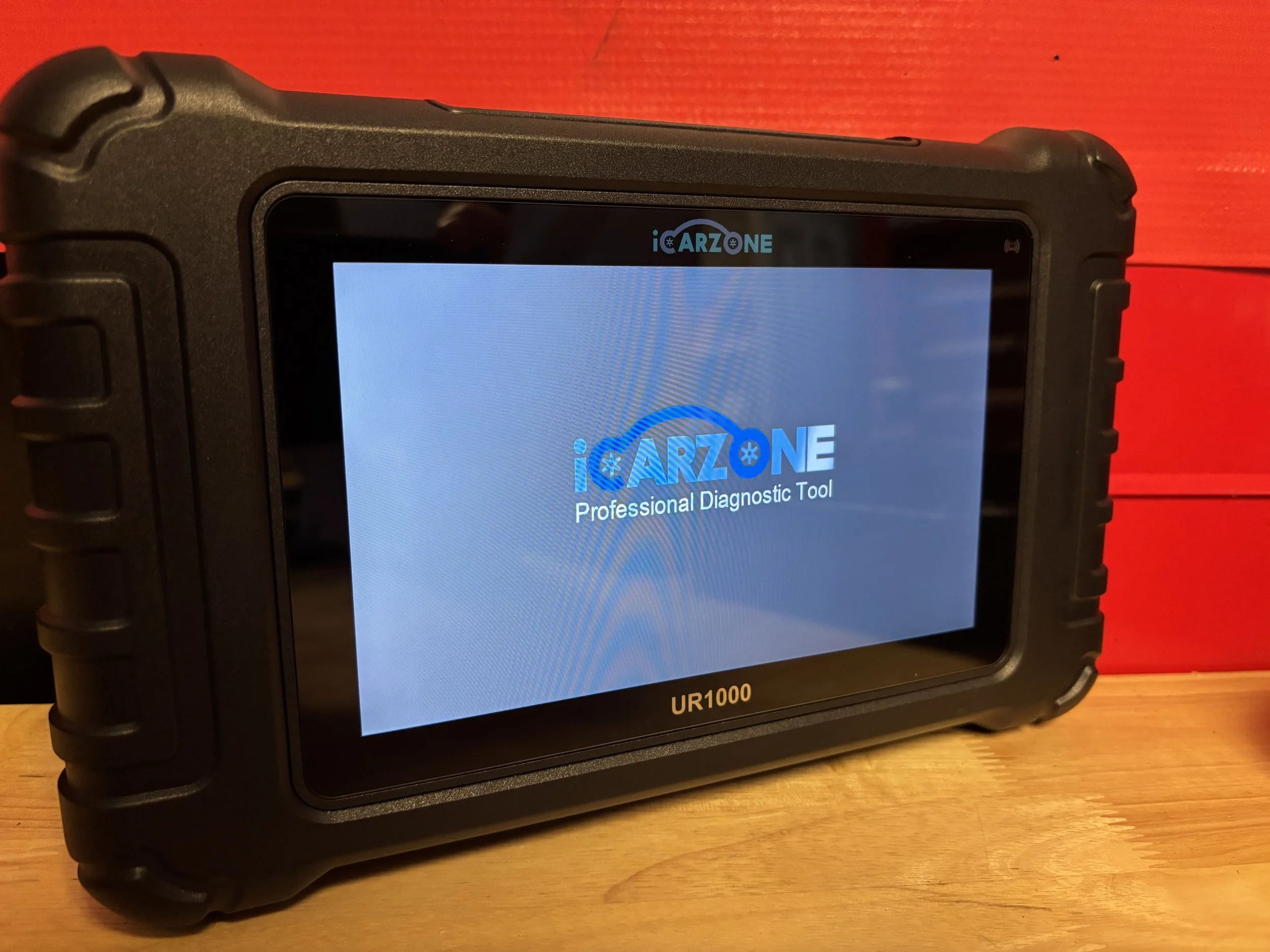
Before running any tests, I updated the UR1000 to the latest firmware and software build, setup wifi and made sure everything was updated. Setup required no account creation or login — power on the tablet, pair the wireless OBD2 dongle over Bluetooth, and it connects. No cable tethering you to the driver's seat; you can walk the vehicle with the tablet while the adapter stays plugged into the OBD2 port.
On usability alone, this is a well-built tool, far better than most that I test. The interface is clean, navigation is intuitive, and the wireless architecture is a genuine upgrade over cable-tethered handheld scanners in this price range.
Test Vehicle 1: 2000 Toyota Tacoma
The Tacoma is an older OBD2-compliant vehicle, which makes it a good stress test for a scanner's protocol and module coverage outside of modern CAN-bus vehicles. Which also should be an easy win for any scan tool, an older truck with a basic computer system.
Auto vehicle ID: Failed. The UR1000 could not automatically identify the truck by VIN/protocol handshake. First I’ve ever seen this.
Deep system access: Limited. Without auto-ID, I couldn't get past basic OBD2-level data into manufacturer-specific modules. Almost nothing to work with here.
I don't expect full bidirectional control on a 26-year-old truck from every scanner — module support varies by manufacturer and model year. But failing basic auto-identification on a common, high-volume vehicle like a first-gen Tacoma is a coverage gap worth flagging, especially for a scanner marketed on its diagnostic depth rather than as an entry-level code reader.

Test Vehicle 2: 2019 Ram 1500
This is a modern platform, and the UR1000 initially started strong here.
Auto vehicle ID: Successful.
Full system scan: Successful — the scanner correctly polled multiple modules and returned results cleanly.
Codes found: 2 DTCs.
Code clearing: Initially failed. After my original testing, ICARZONE contacted me and explained that my 2019 Ram 1500 requires a 12+8-pin adapter to bypass the vehicle's FCA Security Gateway for certain diagnostic functions. ICARZONE overnighted the adapter to me, and I repeated the test. With the 12+8 adapter installed, the UR1000 successfully cleared both codes.
Oil/service reset: Still unsupported. I repeated my service-function testing with the 12+8 adapter installed, but the UR1000 reported that the vehicle was not supported and would not perform the oil/service reset.
So ICARZONE was correct about the Security Gateway affecting my original code-clearing test, and I'm updating the review accordingly. The 12+8 adapter resolved that issue. However, it did not resolve the service-function compatibility issue I encountered with this truck.
It's also important to note that the 12+8 adapter has no bearing on my testing with the 2000 Toyota Tacoma, so those original results remain unchanged.
Head-to-Head: ICARZONE UR1000 vs. MUCAR 682
The comparison with the MUCAR 682 is where the UR1000 becomes especially difficult for me to recommend. The MUCAR costs considerably less and, on paper, feels like the less impressive tool. It's wired rather than wireless, doesn't have the same slick Bluetooth setup, and the overall experience isn't as polished as what ICARZONE has built around the UR1000.
But once I actually connected both scanners to my vehicles, those advantages stopped mattering very quickly.
The MUCAR 682 successfully identified my 2000 Tacoma where the UR1000 couldn't. On the newer 2019 Ram 1500, both scanners communicated with the truck and scanned its systems. After adding the required 12+8 Security Gateway bypass adapter, the UR1000 also successfully cleared the Ram's codes. However, the UR1000 still reported the vehicle as unsupported when I attempted the oil/service reset, while the MUCAR 682 successfully completed that function in my testing.
That makes the comparison closer than it appeared in my original test, and ICARZONE deserves credit for identifying the Security Gateway issue. But the MUCAR still provided broader functionality across the two vehicles I tested, despite costing considerably less.
That's ultimately the distinction that matters to me with a diagnostic tool. The UR1000 provides the nicer experience getting connected to the vehicle, while the MUCAR 682 proved more useful once I was actually there.
I genuinely prefer the UR1000's wireless hardware. Being able to leave the Bluetooth OBD2 adapter plugged in and walk around with the tablet is convenient, and its interface makes the scanner feel like the more modern product. If both tools had performed equally well in my testing, those advantages could easily justify spending more on the ICARZONE.
They didn't.
For diagnostic equipment, functionality has to come before convenience. The 12+8 adapter resolved the UR1000's code-clearing issue on my Ram, but it still couldn't perform the oil/service reset I tested, and it still couldn't automatically identify my 2000 Tacoma. The cheaper MUCAR 682 successfully handled both of those tasks in my testing. Based on my experience with these two vehicles, that's why the MUCAR 682 remains the easier recommendation.
Where This Leaves the UR1000
The retest improves my opinion of the UR1000, but it doesn't completely change my recommendation.
ICARZONE was correct that the FCA Security Gateway affected my original code-clearing test on the 2019 Ram 1500. Once I installed the 12+8 bypass adapter they provided, the UR1000 successfully cleared the codes. That's an important correction, and one I'm happy to make.
What didn't change was the service-function compatibility. Even with the 12+8 adapter installed, the UR1000 reported that my Ram was not supported when I attempted the oil/service reset. My original results with the 2000 Toyota Tacoma also remain unchanged, including the UR1000's inability to automatically identify the truck.
The frustrating part is that I still really like the UR1000's hardware. The wireless connection, tablet, interface, and general user experience are excellent. My concern after retesting is more specifically vehicle and service-function compatibility rather than the broader diagnostic reliability problem I described after my initial testing.
Caveat on Vehicle Compatibility
Diagnostic scanner functionality can vary significantly by make, model, year, and vehicle architecture. My results reflect testing on a 2000 Toyota Tacoma and a 2019 Ram 1500. The Ram also requires an additional 12+8 bypass adapter to get around its FCA Security Gateway for certain diagnostic functions, something that materially affected my original test.
These results should therefore be viewed as my experience with these two specific vehicles rather than a claim about how the UR1000 will perform on every supported vehicle.
Recommendation
After retesting, I still recommend the MUCAR 682 over the ICARZONE UR1000 based on my experience with these two trucks. The 12+8 adapter corrected the UR1000's code-clearing issue on the Ram, but the scanner still couldn't perform the oil/service reset I tested, and my original Tacoma compatibility issues remained.
The UR1000 has the better hardware and wireless user experience. The MUCAR 682 simply completed more of the functions I needed across my two test vehicles while costing considerably less. For me, that makes the MUCAR 682 the easier recommendation.