Disclosure: We may earn a commission when you purchase through links on our site. This does not influence our reviews or recommendations.
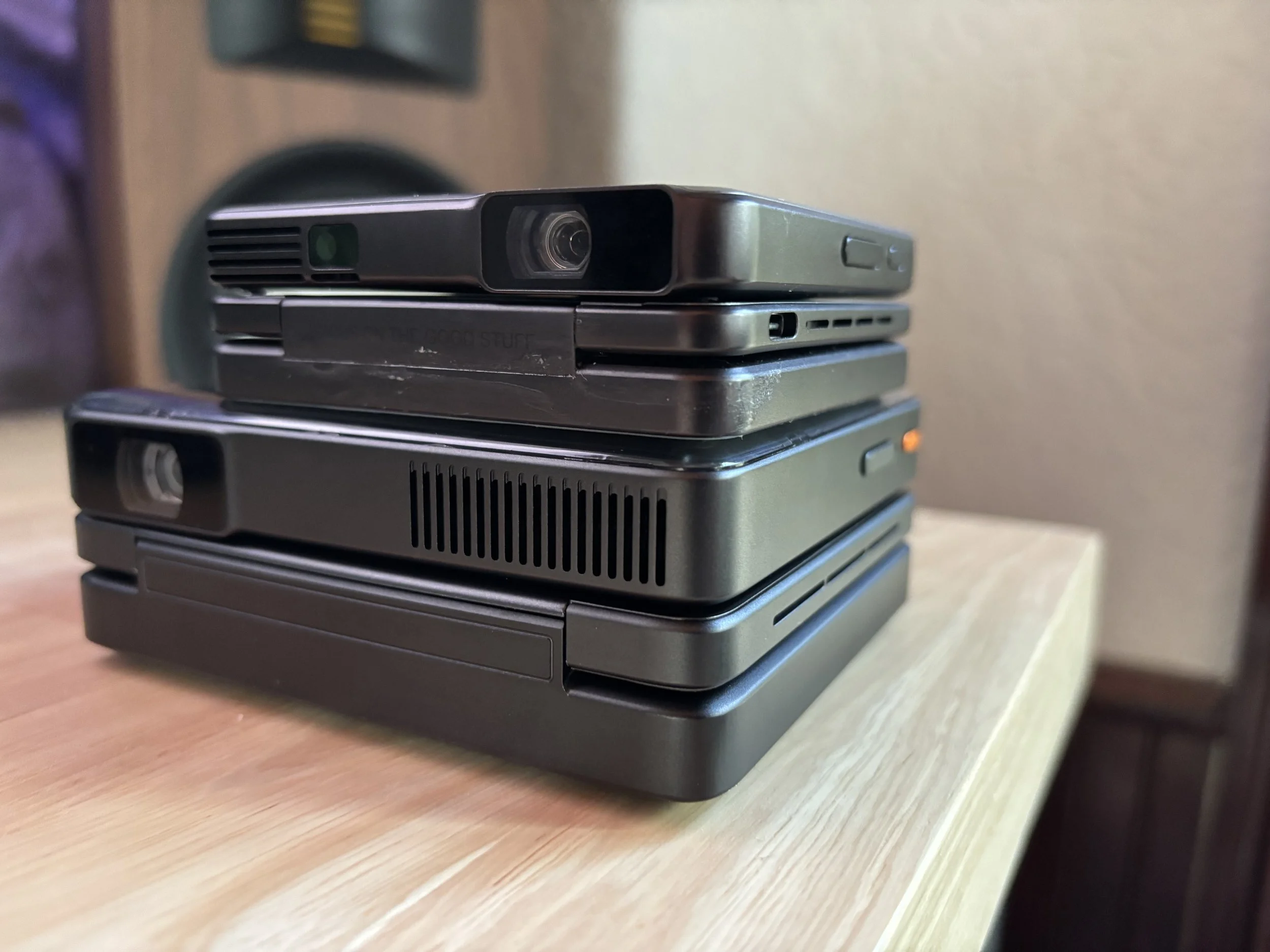
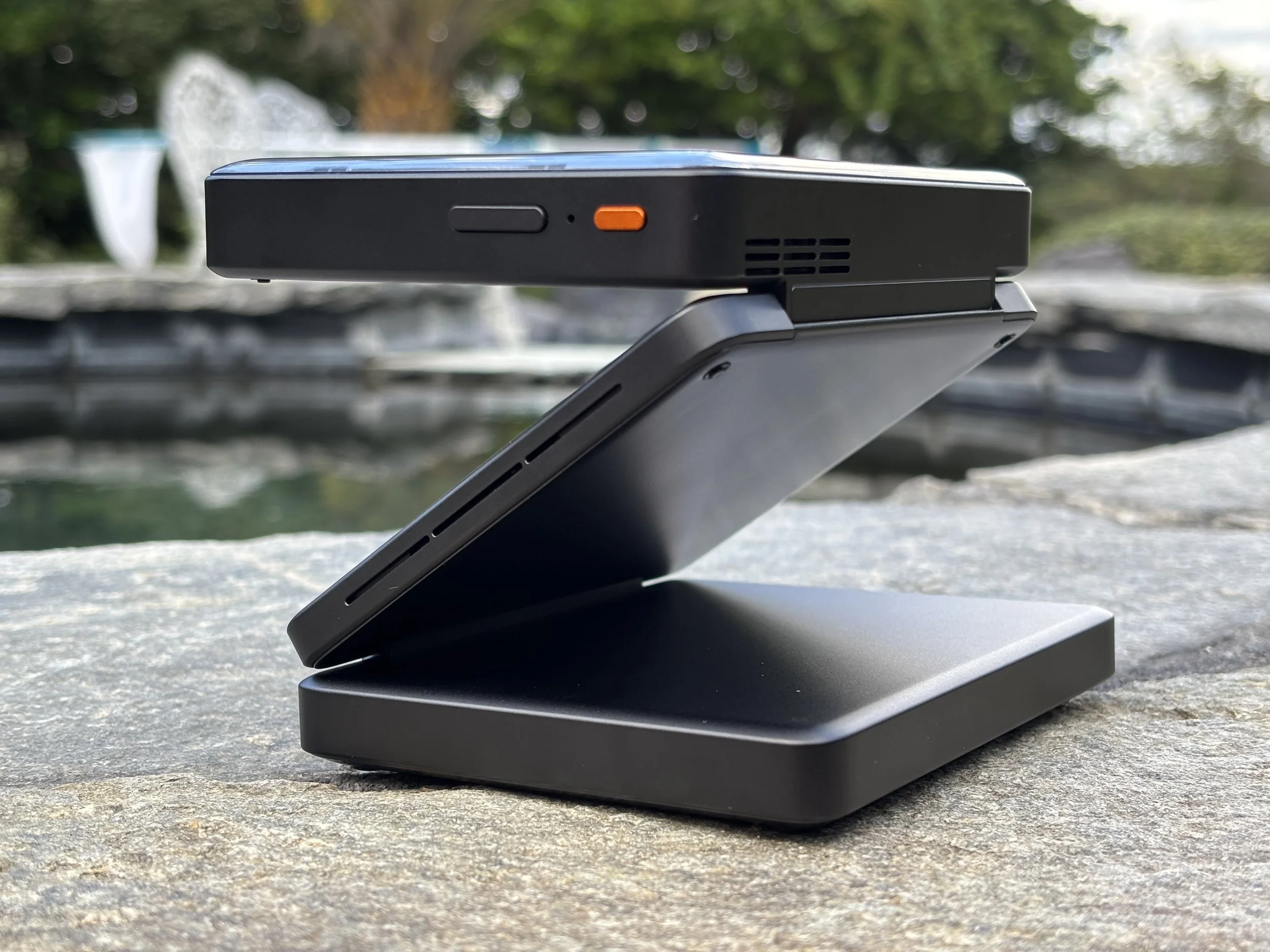
The original Zip on top of the new Zip Pro, you can see the repaired hinge on my zip in this photo (superglue).
My Experience With Both ZIP Projectors
One thing that makes this review a little more interesting is that I also own the original AURZEN ZIP projector, and I've been using it for quite some time. In fact, I've used the original ZIP for everything from casual entertainment to presentations, and it's become one of those little gadgets that I genuinely enjoy having around. When AURZEN announced the new ZIP Pro, I was pretty excited. I was hoping we'd see an upgraded version of the original projector with a little more brightness, perhaps a larger battery, and some improvements to the hardware while maintaining the same incredibly compact design.
Unfortunately….that's not exactly what we got. The original ZIP is substantially smaller than the ZIP Pro. In fact, looking at the two side by side, the original feels like it's roughly a third of the size. That's my visual impression rather than a measured volume comparison, but the difference in portability is immediately noticeable. The original ZIP is what I would consider a true pocket projector. It's approximately the size of my smartphone, and I can comfortably slip it into my pocket and take it almost anywhere. I've actually done exactly that on multiple occasions, including taking it along for presentations where I needed a quick and convenient way to project an image onto a wall.
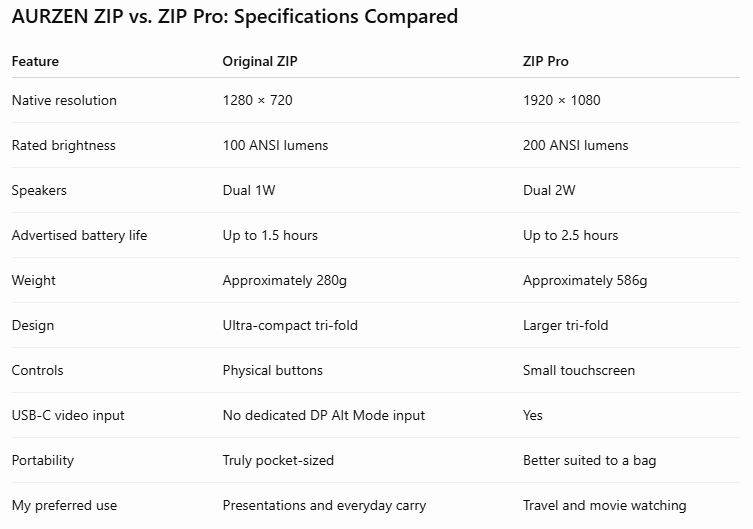
And that's what I really like about the original ZIP. I can pull it out of my pocket, unfold it, and project a surprisingly decent image measuring 75 inches or more onto a suitable wall. No bulky carrying case, no separate tripod, and very little preparation. It's a genuinely useful little device. Of course, the original ZIP has some obvious hardware limitations. It uses a native 720p DLP imaging system rather than the ZIP Pro's 1080p system, produces 100 ANSI lumens instead of 200, and features dual 1W speakers compared to the Pro's dual 2W setup. Battery life is also shorter, with AURZEN advertising approximately 1.5 hours for the original compared to 2.5 hours for the Pro. Those are meaningful differences, and the ZIP Pro is clearly the more capable projector when it comes to picture quality, brightness, audio output, and battery life. However, the original ZIP is significantly easier to carry around. And depending on how you intend to use your projector, I think that's a pretty important advantage.
Long-Term Durability: My Original ZIP Has Already Needed a Repair
There's another interesting detail worth mentioning about my original ZIP, especially since I've been using it for roughly a year. One of the hinges has already failed. Specifically, the lower hinge became damaged, and I ended up repairing it with superglue. That effectively eliminated the movement of the lower hinge, leaving me with only the upper hinge functioning as originally intended. Surprisingly, that hasn't been a particularly significant problem. I've continued using the projector with the repaired lower hinge, and it's remained functional for my purposes. I can still position it and use it for presentations and casual viewing without much difficulty.
However, I do think it's important to mention the failure. The folding design is one of the ZIP's biggest selling points, and the hinges are naturally going to be an area of concern when you're repeatedly opening and closing the projector. My experience doesn't necessarily mean every original ZIP will develop hinge problems, but it's something I've encountered during long-term ownership. It's also part of why I paid attention to the hinges on the ZIP Pro. While I haven't experienced a hinge failure on the newer projector, I would like to see more dampening in its folding mechanism. The sections can snap together pretty abruptly when closing, and a smoother mechanism would make the design feel more refined.
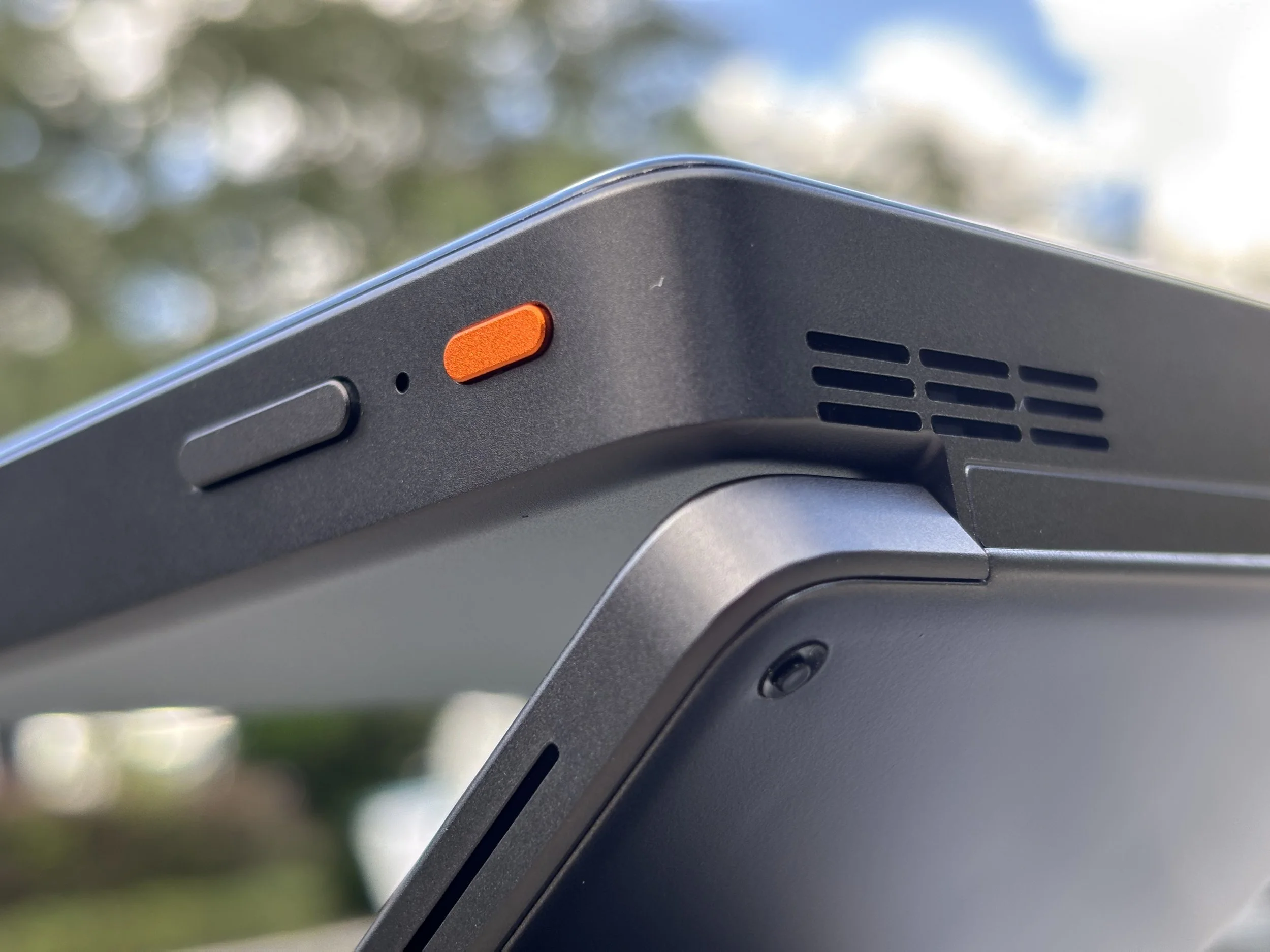
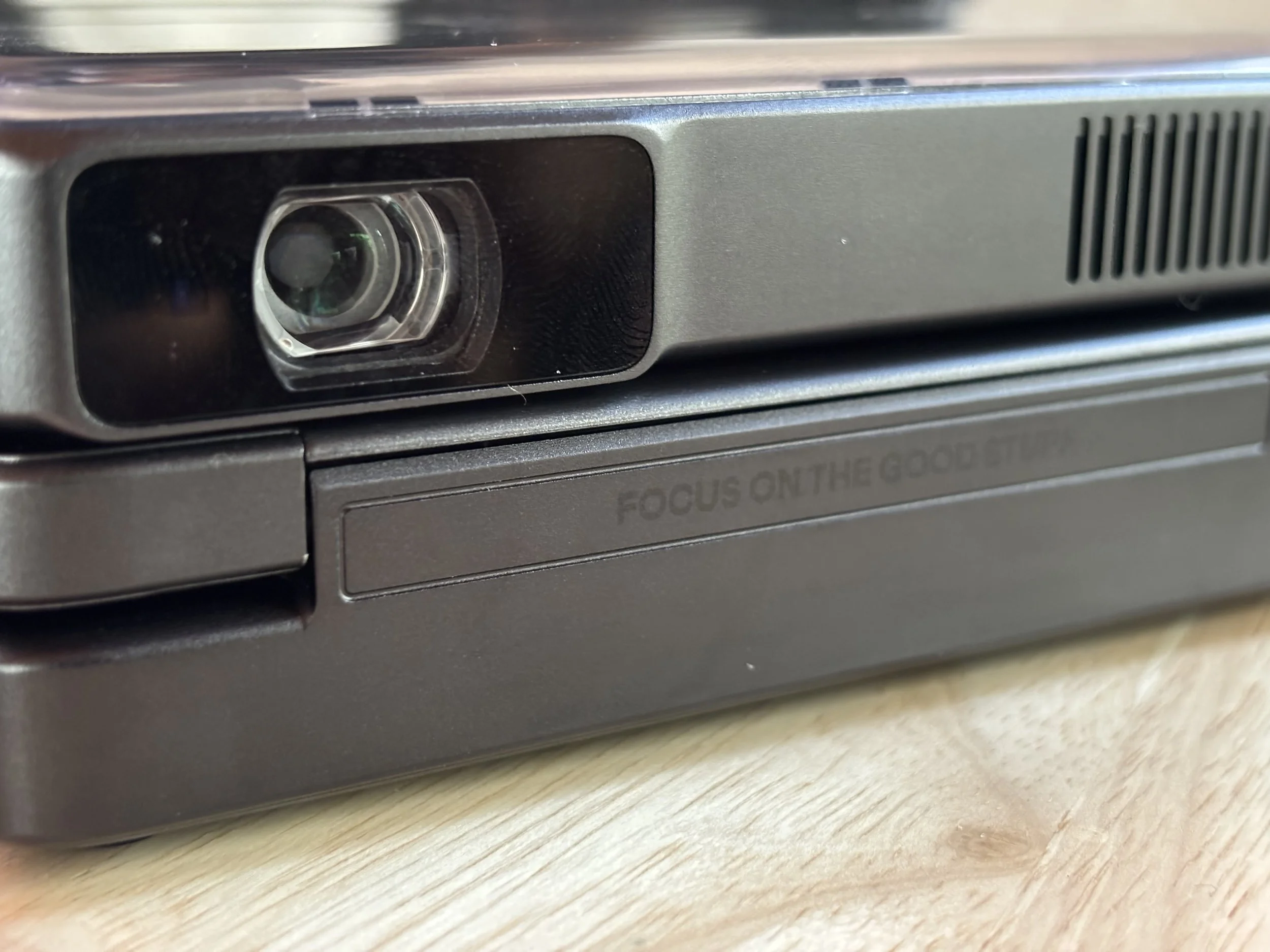
Both the original ZIP and ZIP Pro use AURZEN's unusual tri-fold design. Rather than requiring a separate stand, the projector unfolds into a structure that allows you to adjust the projection angle. It's a clever solution, particularly for something designed around portability. With the ZIP Pro, I can unfold the projector, position it on a desk or nightstand, and adjust the image without having to carry additional mounting equipment. The design also makes ceiling projection possible, which could be useful when watching something from bed. However, I noticed something about the new model that I'd like to see improved. The hinges could use some additional dampening.
When folding the ZIP Pro back into its compact configuration, the different sections have a tendency to snap together rather abruptly. Instead of a smooth, controlled closing action, they can smack against each other. I didn't experience any mechanical failures with the ZIP Pro during my testing, but I would prefer a little more resistance in the folding mechanism. And there's a specific reason I'm paying attention to this.
The ZIP Pro Isn't Quite the Upgrade I Was Hoping For
After using both projectors, I have somewhat mixed feelings about the direction AURZEN took with the ZIP Pro. On one hand, the improvements are substantial. Native 1080p resolution, twice the rated brightness, more powerful speakers, longer battery life, and expanded connectivity are all worthwhile upgrades. The ZIP Pro produces a noticeably more capable projection experience on paper, and I was impressed with its actual picture quality during testing. On the other hand, the original ZIP was appealing precisely because it was so small.
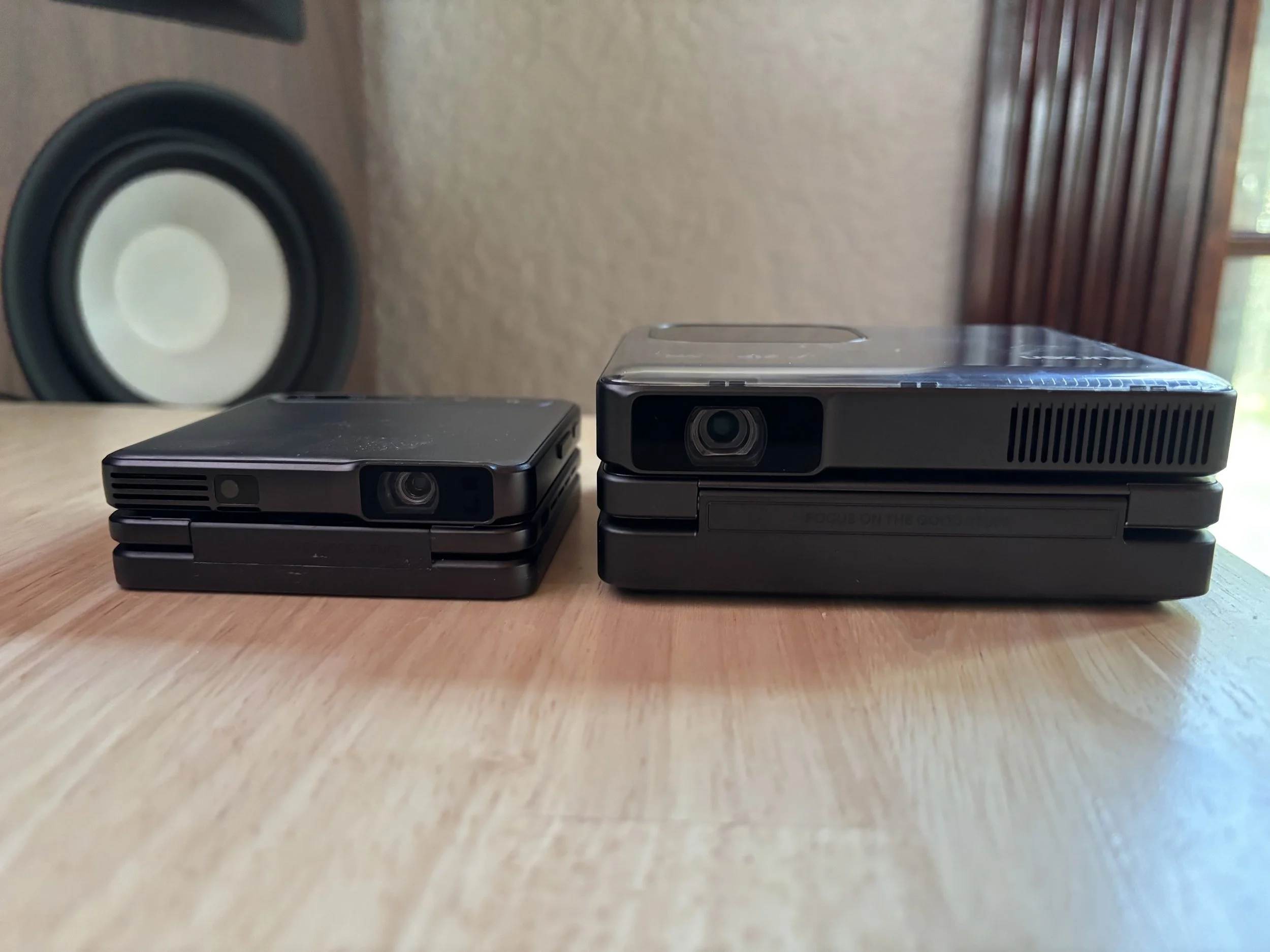
I could put it in my pocket, take it to a presentation, and have a functional projector available without even thinking about carrying additional equipment. The ZIP Pro loses some of that convenience. It's still very portable, but at 1.29 pounds and with a considerably thicker folded design, it's something I'd rather carry in a backpack, laptop bag, or suitcase. And the new touchscreen is a genuine step backward in usability, at least in my experience. What I really wanted was the original ZIP's form factor with some of the Pro's improvements. Give me a little more brightness, a better battery, perhaps a higher-resolution imaging system, and keep those simple physical controls. That would have been an extremely compelling upgrade. Instead, AURZEN has created a somewhat different product. The ZIP Pro prioritizes projection performance and additional features over maximum portability, while the original ZIP remains the better option for someone who wants the smallest possible projector.
Neither approach is necessarily wrong, but they're aimed at slightly different buyers. If I were traveling with a carry-on bag and wanted to watch movies in a hotel room, I'd take the ZIP Pro. If I wanted a projector I could slip into my pocket for an impromptu presentation, I'd still take the original ZIP. And after spending time with both, I think that distinction matters more than the specifications alone.
Design and Portability: The ZIP Pro Is No Longer a True Pocket Projector
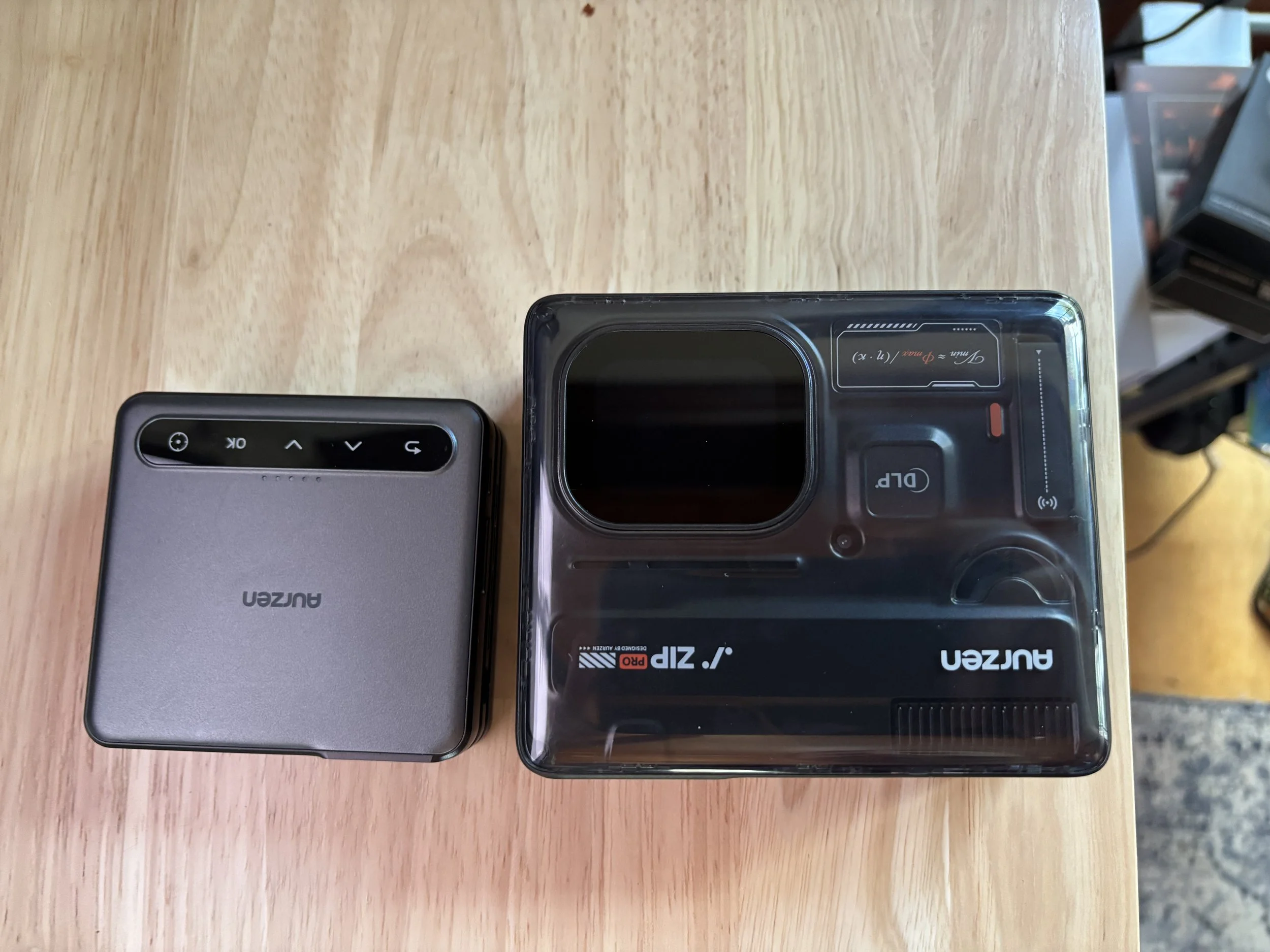
One of the first things I noticed when comparing the ZIP Pro with my original ZIP was just how much larger the new projector is. AURZEN still markets the ZIP Pro as a pocket projector, but I think that description is stretching things a little. Yes, it's compact, especially considering the hardware inside, but at approximately 1.29 pounds and nearly two inches thick when folded, this isn't something I would comfortably carry around in my pants pocket. It also has a surprising amount of heft to it. When you pick it up, the ZIP Pro feels like a substantial little piece of equipment rather than an ultralight gadget. The original ZIP, on the other hand, is genuinely pocket-sized. It's roughly the size of my smartphone, and I've carried it around in my pocket on multiple occasions without much trouble.
Looking at the two side by side, the original feels like it's approximately one-third the size of the new Pro. That's a visual impression rather than a measured volume comparison, but the difference is substantial. And I think that distinction matters more than AURZEN might realize. The original ZIP is the kind of device I can take with me without really planning ahead. If I'm heading somewhere and think I might need to project something onto a wall, I can simply put it in my pocket and go. I've actually used it this way for presentations. Being able to pull a projector out of my pocket, unfold it, and produce a reasonably good 75-inch-plus image onto a suitable wall is pretty impressive.
The ZIP Pro doesn't offer that same level of convenience. However, it does make considerably more sense as a travel projector. If you're packing a suitcase, laptop bag, or carry-on, the ZIP Pro is still an excellent size. It's much smaller than a traditional projector, and the folding design eliminates the need for a separate tripod in many situations. For hotel rooms, bedrooms, or temporary setups, I think the ZIP Pro's size is perfectly reasonable. But for someone who wants a projector they can literally slip into their pocket, the original ZIP remains the better option.
Picture Quality: The ZIP Pro Is a Significant Upgrade
If there's one area where the ZIP Pro clearly improves on the original, it's picture quality. The original ZIP uses a native 720p DLP imaging system rated for 100 ANSI lumens. Considering its extremely small size, I've always thought the picture was pretty respectable. As I mentioned earlier, I've used the original ZIP to project images measuring 75 inches or more onto suitable walls. For presentations and casual viewing, it has worked surprisingly well. However, the ZIP Pro takes things considerably further.
The new model uses a native 1920 × 1080 DLP imaging system with an LED light source, increasing the total pixel count from approximately 921,600 pixels to more than 2 million. That's 2.25 times as many native pixels as the original ZIP. AURZEN has also doubled the rated brightness from 100 ANSI lumens to 200 ANSI lumens. Now, 200 ANSI lumens still isn't particularly bright compared to conventional home theater projectors. Some larger models produce several thousand lumens, and even relatively compact portable projectors can offer considerably more light output. However, when you consider the ZIP Pro's physical dimensions, I think the picture quality is impressive.
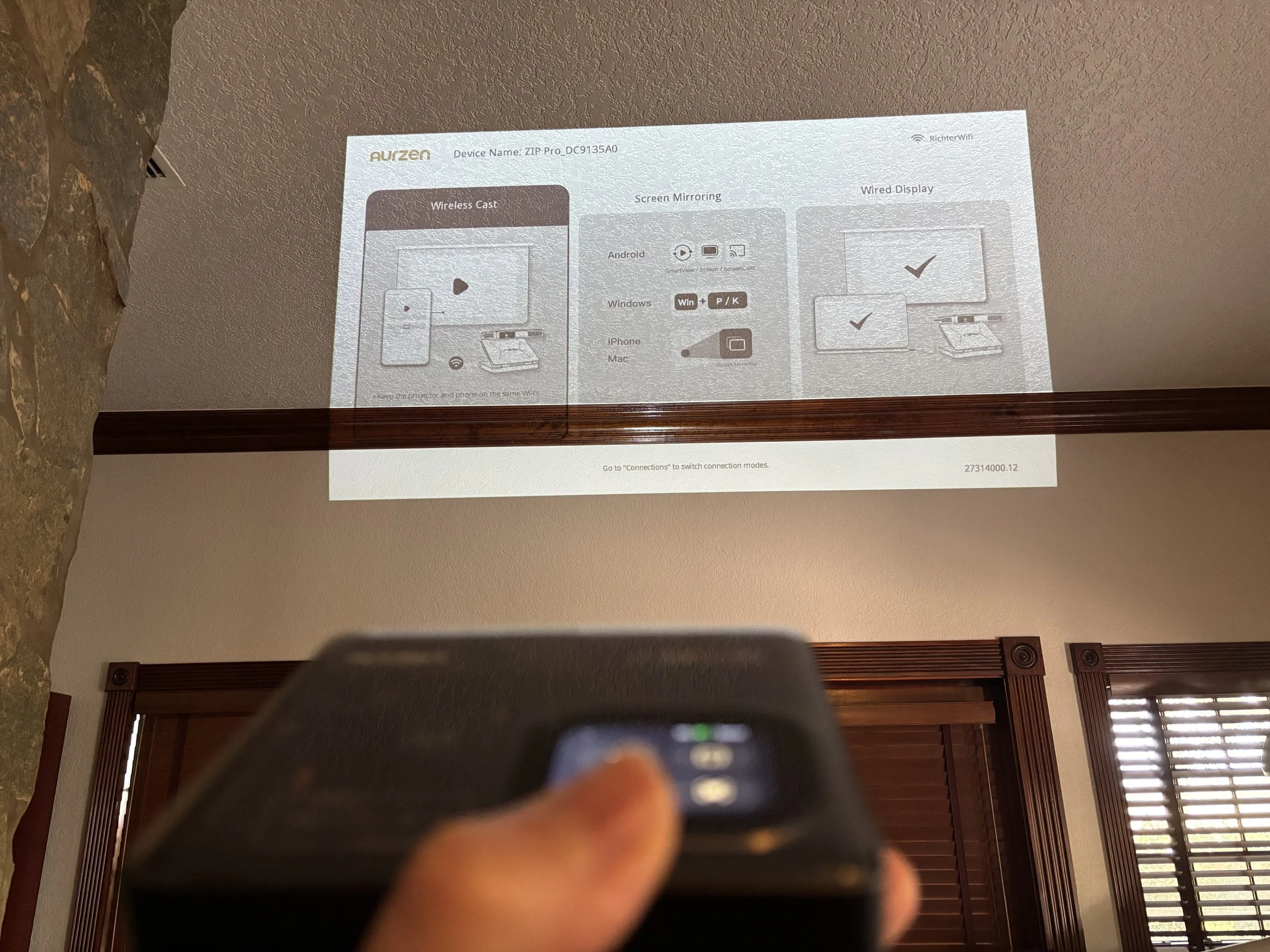
During my testing, I experimented with several projected image sizes and was consistently pleased with the results. Even when pushing the image larger, the ZIP Pro delivered an attractive picture. The additional resolution is particularly welcome when viewing detailed content. The original ZIP's 720p image is acceptable for many casual applications, but the Pro's native 1080p resolution gives it a substantial advantage when projecting Full HD material. The extra brightness also helps, particularly when increasing the image size. Of course, the ZIP Pro still performs best in a dark environment. This isn't something I'd recommend for watching movies in a brightly lit living room or outdoors during the daytime. AURZEN recommends a 60- to 80-inch image in a dark room, although the projector is capable of producing images up to a claimed 115 inches.
It's important to understand that increasing the image size reduces the amount of light available per unit of screen area. A 100-inch image spreads the same light across approximately 2.8 times the area of a 60-inch image, so ambient light becomes increasingly important as you increase the projection size. For hotel rooms, bedrooms, and other environments where you can control the lighting, the ZIP Pro produces a surprisingly good picture. I didn't perform instrumented brightness, contrast, or color accuracy measurements, so my observations are based on actual viewing rather than laboratory testing. However, after using both projectors, I have no problem saying that the ZIP Pro is the more capable display. It's just unfortunate that AURZEN couldn't deliver some of these improvements in something closer to the original ZIP's dimensions.
The Original ZIP Has Better Controls, and That's Frustrating
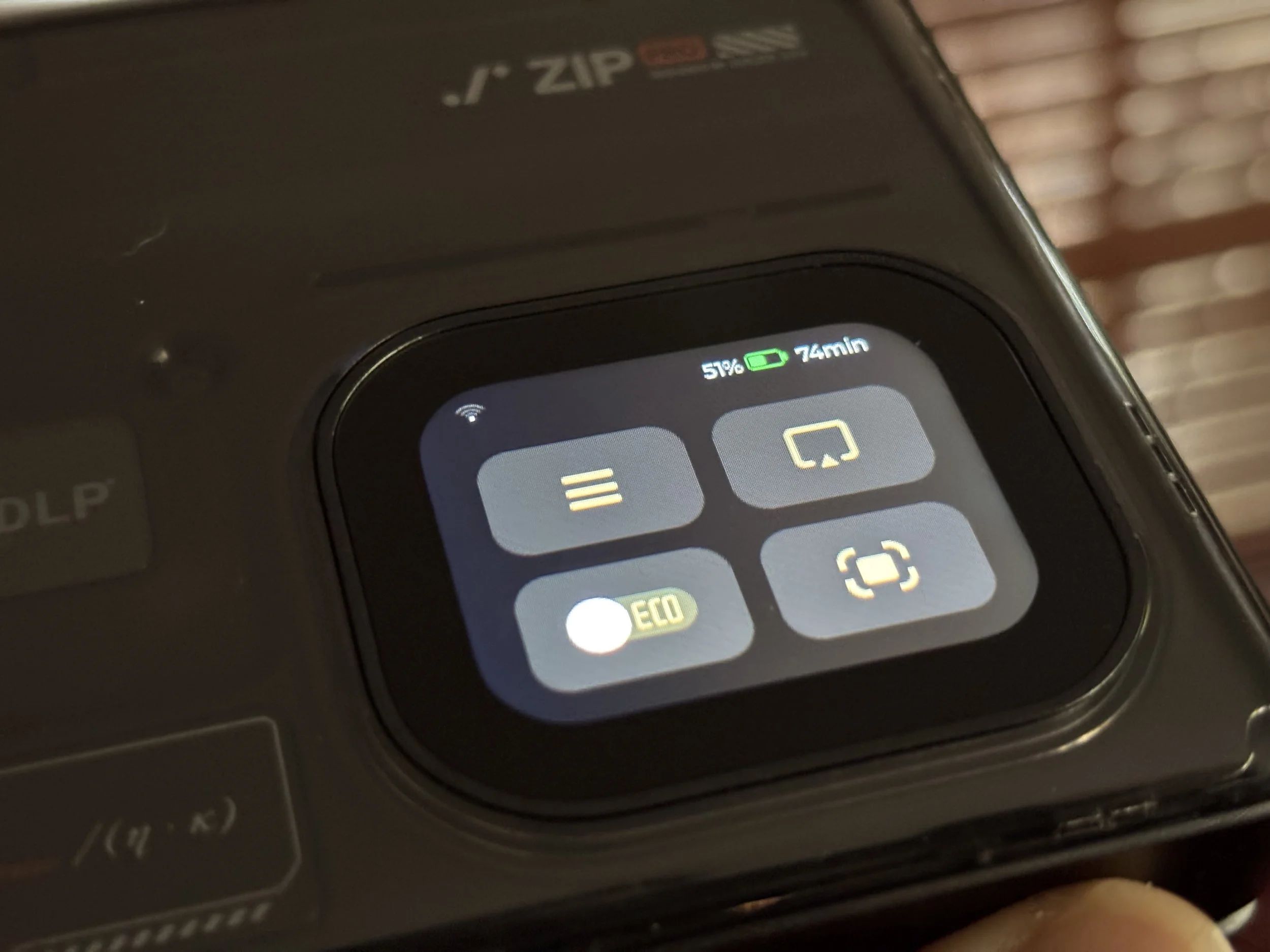
This is probably the most disappointing change AURZEN made with the ZIP Pro. The original ZIP uses physical buttons for its controls, and I've always found them relatively straightforward to operate. They're simple, accessible, and easy enough to use without fighting with a miniature touchscreen. The ZIP Pro replaces that approach with a small touchscreen on top of the projector. On paper, that sounds like an upgrade. Touchscreens can provide more flexible interfaces, and integrating the controls directly into the projector makes sense for a portable product. Unfortunately, the implementation is pretty terrible.
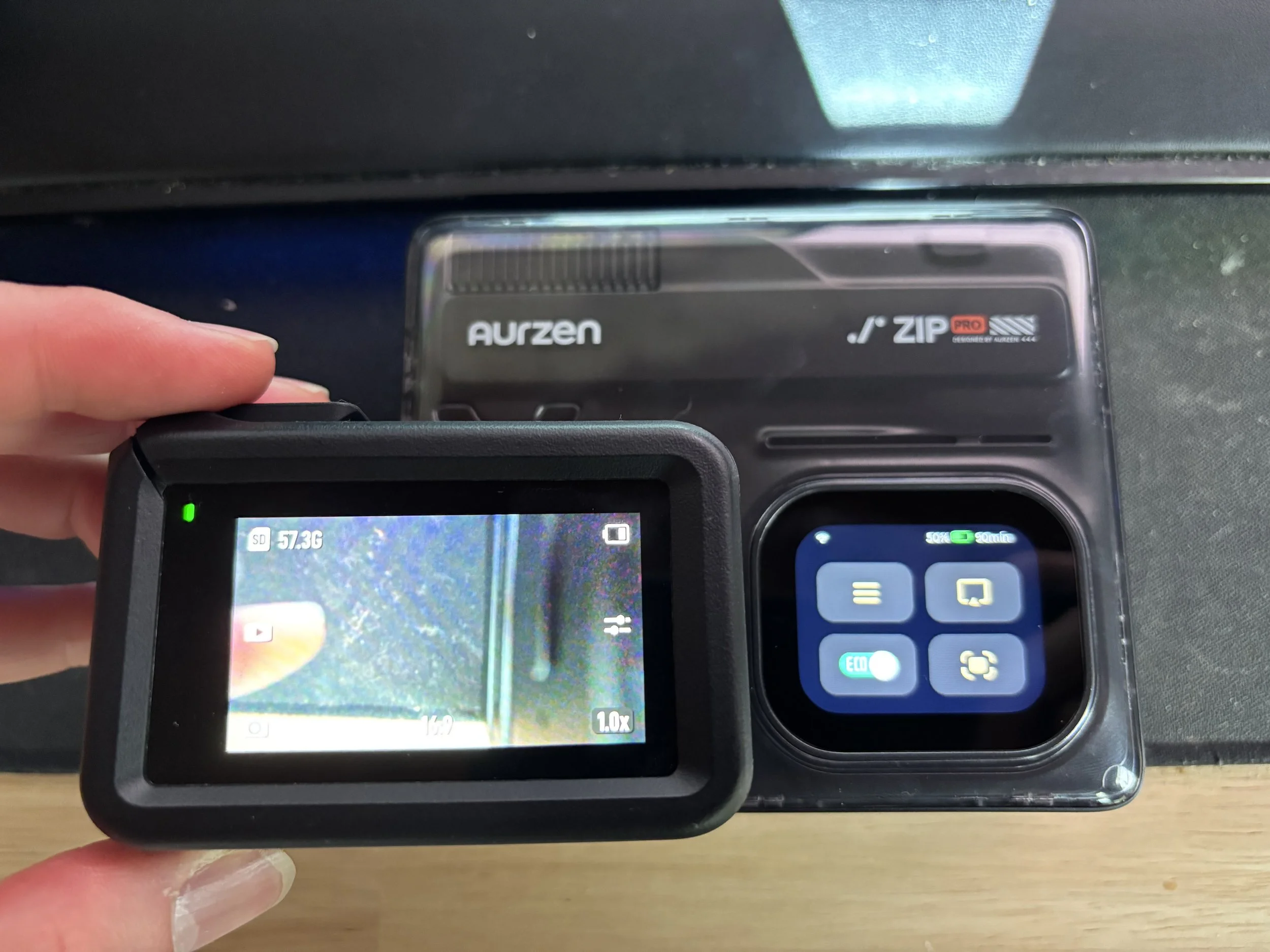
DJI Osmo Action 4 next to the Zip Pro, big touch screen size difference.
The screen is simply too small. One of the most frustrating parts of my testing was entering my Wi-Fi password. AURZEN provides a tiny on-screen keyboard, and trying to select individual letters with your fingers is incredibly difficult. I found myself repeatedly wondering why AURZEN didn't simply make the display larger. There's a reasonable amount of available space on top of the projector, and even a modest increase in touchscreen size would make the interface considerably easier to navigate. For comparison, I have DJI camera equipment with small touchscreens that are substantially easier to use. In fact, one of my cameras actually has a larger touchscreen than the ZIP Pro.
That's pretty ridiculous when you consider how much interaction the projector requires during setup. The problem isn't limited to entering passwords, either. Navigating menus and changing settings can become frustrating because the controls are so small. A stylus might help, but I didn't have one available during testing, and I don't think a portable projector should require one just to enter a Wi-Fi password comfortably. AURZEN does offer its AurzenHub companion app as another way to interact with compatible projectors, but that doesn't change my opinion about the integrated controls.
After using both generations, I actually prefer the original ZIP's physical buttons. Setup is easier, the controls are less frustrating, and I don't feel like I'm fighting the projector just to change a setting. That's a disappointing result for a product that's supposed to be the more advanced model. I understand why AURZEN wanted to modernize the interface, but I think the company would have been better off retaining the original physical controls or installing a substantially larger touchscreen. As it stands, the ZIP Pro's interface is easily my biggest complaint.
Connectivity: The ZIP Pro Adds Some Useful Features
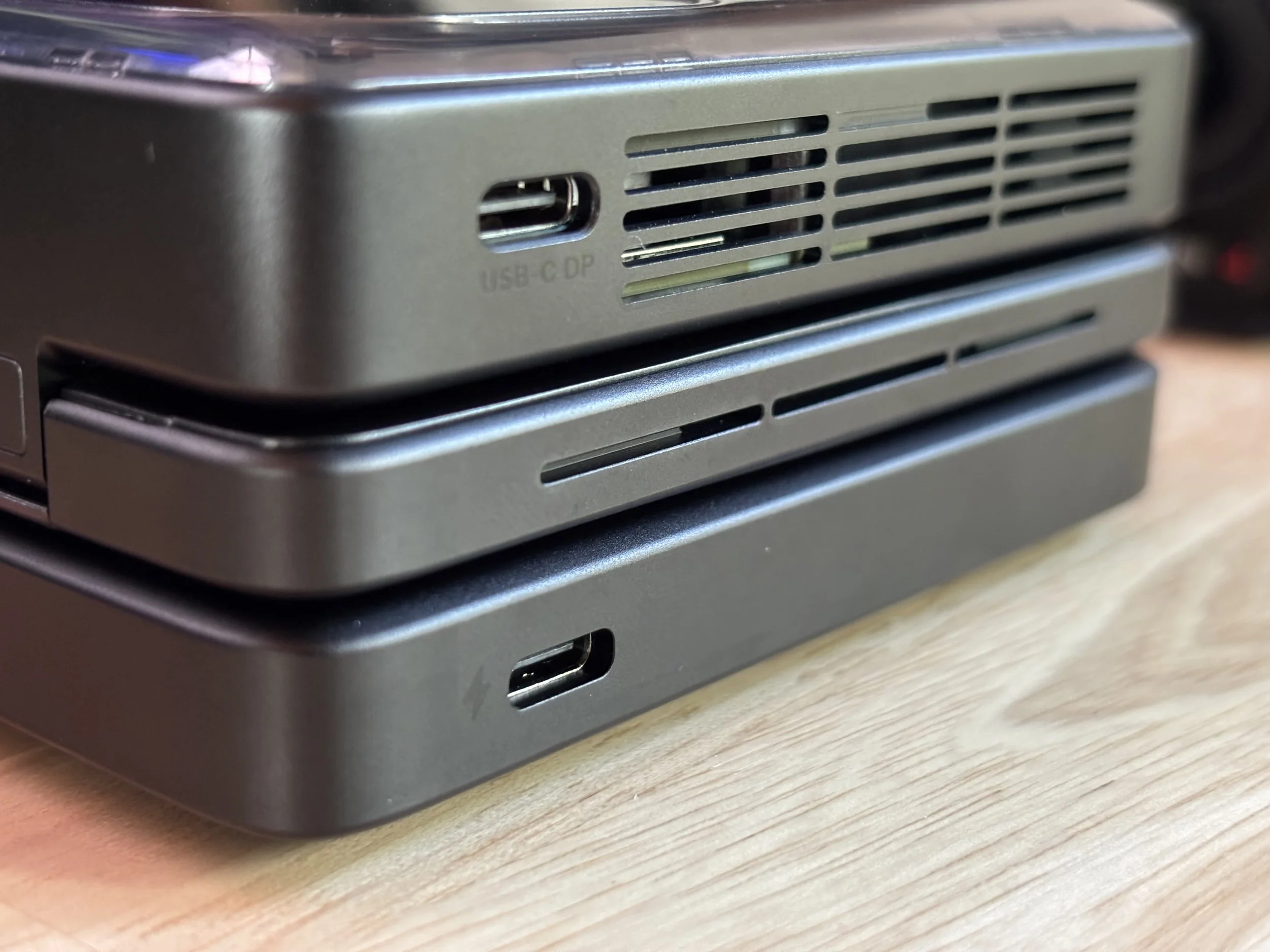
One area where the new projector has a clear advantage is connectivity. The ZIP Pro supports several wireless casting technologies, including AirPlay P2P, Miracast, DLNA, Google Cast, and AURZEN's AirLink system. It also supports dual-band Wi-Fi and Bluetooth 5.4, giving users several ways to connect compatible devices. However, one of the most useful additions is the dedicated USB-C video input with DisplayPort Alt Mode support. This allows compatible laptops, tablets, handheld gaming systems, and other devices to send video directly to the projector through a wired connection. I think that's particularly useful for a travel projector because wireless casting isn't always the most convenient option.
Hotel Wi-Fi networks can sometimes complicate device discovery and screen mirroring, and there are situations where having a direct wired connection is simply easier. AURZEN also advertises a low-latency gaming mode, with a claimed response time of approximately 20–40 milliseconds when using a compatible wired USB-C connection. I didn't independently measure input latency, so I can't verify those figures. However, it's nice to see the company including gaming-oriented features. The ZIP Pro also uses time-of-flight autofocus and four-point keystone correction, which are particularly useful when you're frequently moving the projector between different locations.
AURZEN specifies a 1.2:1 throw ratio. For an 80-inch diagonal 16:9 image, that works out to a projection distance of approximately seven feet. That's something to keep in mind if you're planning to use the projector in smaller hotel rooms or bedrooms. One other detail worth understanding is that the ZIP Pro uses a Linux-based screen-mirroring platform rather than a conventional Google TV operating system. That means the projector is primarily designed around connecting or casting from another device rather than functioning as a completely independent streaming television. Personally, I don't consider that a major drawback. I already have plenty of devices capable of providing content, and the ability to connect them directly is more important to me than having another streaming interface. However, buyers expecting a built-in Netflix or Google TV experience should understand the difference.
Audio Quality: The ZIP Pro Doubles the Speaker Output
The original AURZEN ZIP uses dual 1W speakers, which are perfectly reasonable considering how small the projector is. However, the ZIP Pro doubles that output with a pair of 2W stereo speakers, providing a total of four watts. That still doesn't sound like much, but I was pleasantly surprised by the audio performance during testing. I don't usually spend much time discussing the built-in speakers on projectors because, in most cases, they're simply there for convenience. However, with a device like the ZIP Pro, the speakers are an important part of the experience. If you're traveling with this projector, you're probably not going to bring a soundbar or a separate speaker system. The entire appeal is having a compact entertainment system that doesn't require a bunch of additional equipment.
For that purpose, I think the ZIP Pro's speakers are quite good. They provide a perfectly reasonable listening experience for casual movie watching, and I was impressed with what AURZEN managed to squeeze into such a compact housing. Obviously, you're not getting the same experience as a dedicated audio system. But that's not really the point. The ZIP Pro also supports Bluetooth 5.4, including the ability to connect two compatible Bluetooth headphones simultaneously. That's a useful feature for travel, especially if you're watching something with another person and don't want to disturb anyone nearby.
There's also support for digital audio output through the projector's USB-C charging/S/PDIF interface. Overall, the ZIP Pro has a clear advantage over the original ZIP when it comes to audio capabilities, although I still think the original's smaller speakers are adequate for the kind of quick presentations and casual viewing I typically use it for.
Battery Life: My ZIP Pro Lasted 2 Hours and 15 Minutes
AURZEN has also improved battery life with the ZIP Pro. The original ZIP is advertised to provide approximately 1.5 hours of battery life, while the ZIP Pro increases that figure to as much as 2.5 hours in ECO mode. The new projector uses a 38Wh rechargeable battery, which helps explain some of the additional size and weight. During my testing, I managed to get approximately two hours and 15 minutes of runtime from the ZIP Pro. What makes that result interesting is that I wasn't trying to conserve power. I ran the projector at maximum brightness and maximum volume to see how long it would last under demanding conditions.
Despite those settings, the ZIP Pro came within approximately 15 minutes of AURZEN's advertised ECO-mode runtime. I think that's a pretty good result. Two hours and 15 minutes is enough to watch most standard-length movies without needing to connect the projector to an outlet. Longer films will obviously require external power, but for casual viewing and travel, the battery life is quite respectable. Actual runtime will vary depending on brightness, volume, content, battery condition, and other factors. The ZIP Pro also supports 65W USB-C Power Delivery charging, which is a welcome feature. Rather than relying on a proprietary charging connector, it can use a compatible USB-C PD power source.
That's particularly convenient when traveling because you may already have compatible charging equipment for a laptop or other devices. While I appreciate the additional battery life, I also think it's worth considering the trade-off. The original ZIP's smaller battery helps keep the projector incredibly compact. The ZIP Pro's larger battery provides more runtime, but it also contributes to a device that's substantially heavier and less pocket-friendly. For watching movies, I prefer the additional battery life. For quick presentations, the original ZIP's smaller dimensions are often more useful.
Cooling and Fan Noise: The ZIP Pro Is Pretty Loud
Unfortunately, the ZIP Pro's cooling system is another area where I think AURZEN could improve the design. The fans are noticeably loud, and during my testing, I found the noise somewhat distracting. I understand why this happens. AURZEN has packed a DLP projection system, LED light source, battery, stereo speakers, and supporting electronics into a relatively small chassis. That's a lot of hardware generating heat in a compact space. The projector also becomes noticeably warm during operation, so the cooling system clearly has some work to do. However, that doesn't change the fact that the fans are louder than I would prefer. AURZEN publishes operating noise figures of 24dB in ECO mode, 28dB in Normal mode, and 35dB in Conference mode. Those are manufacturer-provided figures, and I didn't independently measure fan noise with a sound meter. In actual use, I found the cooling system noticeable enough to draw my attention, particularly during quieter scenes when the built-in speakers weren't producing much sound.
It's not something that completely ruins the experience, but it does detract from an otherwise impressive projector. I'd love to see AURZEN improve the cooling acoustics in a future revision, whether through better airflow, quieter fans, or changes to the internal cooling system. Obviously, adequate cooling is important, especially with hardware this compact. But for a projector designed around casual entertainment, fan noise is something that deserves attention. Along with the touchscreen, this is one of the ZIP Pro's biggest weaknesses. The specifications make it clear that the ZIP Pro is a substantial upgrade in terms of projection hardware.
However, they don't tell the entire story. The original ZIP is less than half the weight of the new model, and the difference in physical size is significant. It's also easier to operate, at least in my experience. That makes the decision between these two projectors a little more complicated than simply buying whichever one has the better specifications.
What I Wish AURZEN Had Done Differently
If I could design the next generation of the AURZEN ZIP, I'd actually start with the original model rather than the Pro. I'd keep the original's incredibly compact dimensions and physical controls, then focus on improving the projection hardware. A little more brightness would be welcome, even if it meant a modest increase in size. A higher-resolution imaging system would also be nice, although I understand there are practical limitations when trying to fit everything into such a small package. I'd also like to see improved battery efficiency and a more durable hinge mechanism. After experiencing a hinge failure on my original ZIP, that's something I'd pay particular attention to. And if AURZEN wants to continue using a touchscreen on the Pro models, it absolutely needs to be larger. I don't think the current implementation is a good replacement for the original physical controls. I'd also like to see quieter cooling fans and some dampening in the folding mechanism so the sections don't snap together quite so abruptly.
None of these changes would require AURZEN to completely rethink the concept. The company already has a clever design. It just needs to refine a few areas. If I were traveling and wanted a projector for watching movies in a hotel room, I'd choose the ZIP Pro. The native 1080p resolution, additional brightness, improved speakers, and longer battery life make it the better entertainment device. It's also compact enough to fit comfortably in a carry-on bag or laptop bag, and the folding stand makes setup relatively convenient. However, if I wanted a projector I could carry around without thinking about it, I'd still choose the original ZIP. I've already used the original for presentations and other situations where having a projector available on short notice is useful. The fact that I can simply slip it into my pocket and go is something I really appreciate. Even with its lower resolution and brightness, the original ZIP remains a surprisingly capable little projector.
And despite having a damaged lower hinge that I repaired with superglue, I've continued using it without much trouble. That's not exactly a glowing endorsement of the original model's hinge durability, but it does demonstrate how useful I've found the projector despite its limitations. The ZIP Pro is unquestionably more capable in several important areas, but it also feels like a different category of product. The original ZIP is a genuinely pocket-sized projector. The ZIP Pro is a compact travel projector. Those might sound like similar descriptions, but after using both, I think there's a meaningful difference. I would not call the pro a upgrade from the original, it’s basically a new model.
Final Verdict: The ZIP Pro Is Better, But I Still Love the Original ZIP
After spending time with the AURZEN ZIP Pro, I think it's an excellent compact projector with a few frustrating flaws. The picture quality is fantastic for something this small, and the native 1080p resolution is a welcome improvement over the original ZIP. The additional brightness, more powerful speakers, longer battery life, and expanded connectivity also make it a considerably more capable entertainment device. I was particularly impressed by the picture quality during my testing. Even when experimenting with larger projected images, the ZIP Pro delivered an attractive viewing experience. Battery life was another highlight. Getting approximately two hours and 15 minutes at maximum brightness and volume is a strong result, especially for a projector with such compact dimensions.
However, I can't ignore the things AURZEN got wrong. The touchscreen is far too small, and trying to enter a Wi-Fi password or navigate settings can be incredibly frustrating. The cooling fans are also louder than I'd like, and the folding mechanism could use some additional refinement. More importantly, the ZIP Pro isn't quite the successor I was hoping for. I wanted something closer to the original ZIP's size with improved hardware. Instead, AURZEN developed a considerably larger projector that prioritizes performance over maximum portability. That's not necessarily a bad decision, but it changes what makes the product appealing.
The original ZIP remains one of the few projectors I've used that genuinely deserves to be called pocket-sized. I've carried it around for presentations, projected surprisingly large images from it, and continued using it even after repairing a damaged hinge. The ZIP Pro is better suited to traveling with a bag, watching movies in a hotel room, or setting up a temporary entertainment system where picture quality matters more than absolute portability. Both projectors have their strengths, and I think AURZEN has created two products that serve somewhat different purposes. If you're looking for the better overall projection experience, buy the ZIP Pro. If you're looking for a genuinely pocket-sized projector that you can carry almost anywhere, I still think the original ZIP has a lot going for it. Personally, I'm glad AURZEN is continuing to develop the tri-fold concept. It's one of the more interesting portable projector designs on the market, and both generations demonstrate why the idea has potential. I just hope the next model combines the ZIP Pro's improved picture quality with more of the original ZIP's portability and ease of use.