Why Does Every New TV Need an Hour of Updates Before You Can Use It?
Disclosure: We may earn a commission when you purchase through links on our site. This does not influence our reviews or recommendations.
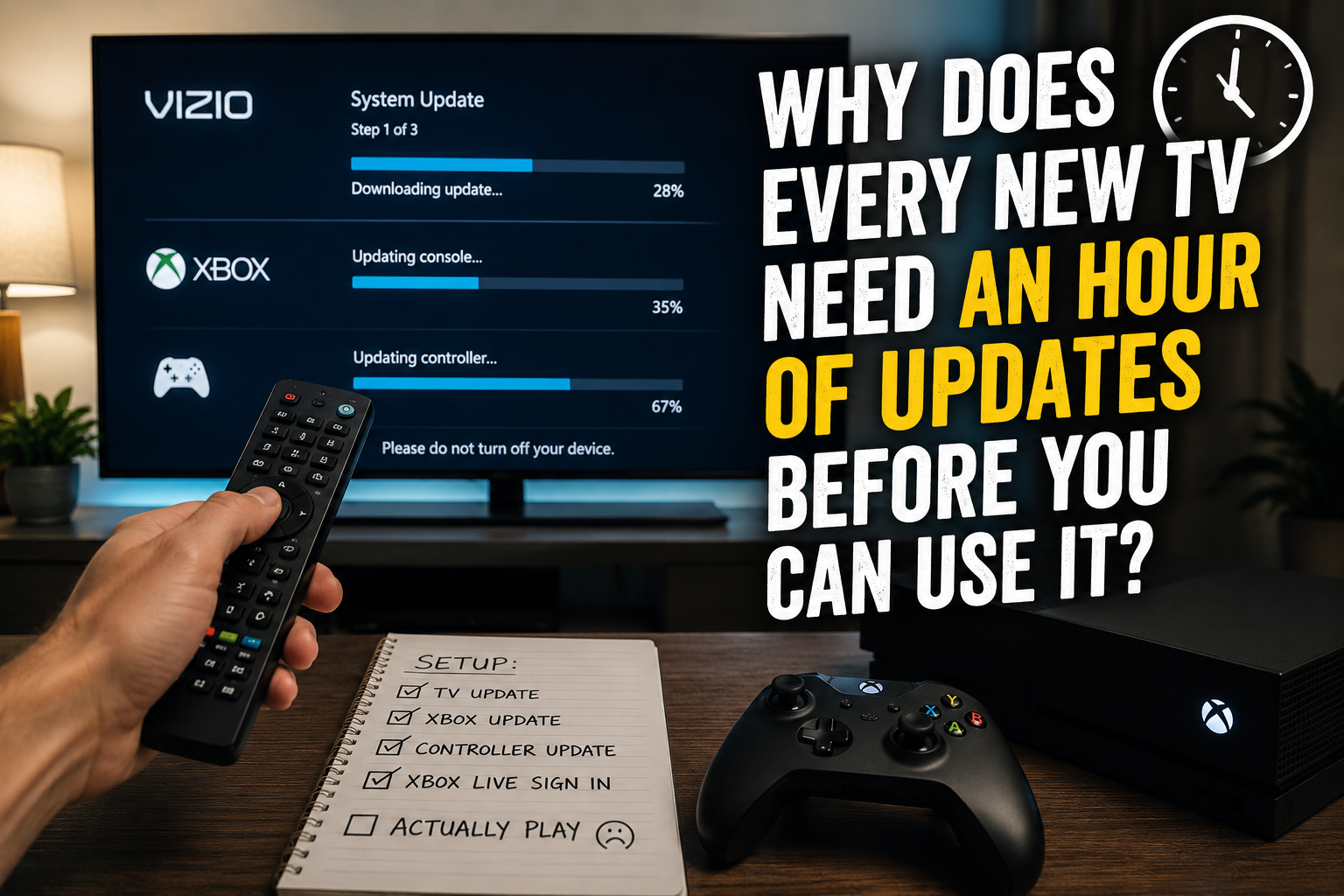
I bought a TV. Or at least that's what the receipt said. What I actually bought was an hour of progress bars. I got the box open, found an outlet, and plugged in a brand-new Vizio. It powered on, thought about it for a second, and told me it needed to download an update before I could do anything else. Fine. I waited. It updated, rebooted, and then asked me to create an account, agree to a wall of terms I didn't read, and connect to Wi-Fi before it would let me near the home screen.
Then I plugged in the Xbox. The Xbox needed an update too. So did the controller. Then Xbox Live wanted me to sign back in, on a screen keyboard, one letter at a time, with a remote that itself needed new batteries because apparently that's part of the ritual now. By the time a game actually loaded, I'd spent close to an hour watching things load that weren't the thing I paid for. Best TV Deals on Amazon!
The TV Is the Real Offender Here
I want to be fair to Xbox and the controller — updates on those are at least in service of something, usually security or performance. Vizio doesn't get that same benefit of the doubt.
This is a company that got caught, red-handed, running software that captured a live snapshot of your screen every second and matched it against a database to figure out exactly what you were watching — then sold that, plus your income, age, education level, and home ownership status, to advertisers. Not "collected some anonymized analytics." Sold individual household profiles. The FTC and the state of New Jersey fined Vizio $2.2 million for it in 2017. Vizio didn't admit wrongdoing, because settlements let you write a check instead of a confession.
So when a Vizio TV spends its first twenty minutes of life "phoning home" before it'll show you a picture, forgive me for not assuming it's just checking for bug fixes. The update screen isn't a courtesy. It's the on-ramp to an ad business.
That ad business, by the way, is now the whole point of the company. Vizio's TV hardware barely turns a profit — the panels are cheap, the margins are thin, and everybody in the industry knows it. The money is in the software layer sitting on top: the ad-supported free channels, the data pipeline, the "smart" in Smart TV. Walmart didn't pay $2.3 billion to acquire Vizio in December 2024 because it wanted to get into the TV-manufacturing business. It bought a TV-shaped advertising platform with a screen attached, so it could bolt Vizio's viewing data onto Walmart's retail data and sell better-targeted ads through Walmart Connect. You are not the customer. You are the on-ramp to the customer.
None of that stops Vizio from making you sit through a mandatory update before you can even skip the ads. Best TV Deals on Amazon!
Zoom Out From Vizio and the Pattern Is Everywhere
I'm not just annoyed at one company. This is bigger than Vizio, even if Vizio is a particularly ugly example.
Twenty years ago, "setting up" a TV meant plugging it in. Today it means:
Connect to Wi-Fi
Accept the terms
Create an account
Install an update
Restart
Install another update
Update the accessories
Sign in again
Somewhere along the way, manufacturers decided your first hour with a new device should be spent maintaining it, not using it. The device ships in a state its own creators consider unfinished, and you're the one stuck watching the progress bar while it catches up to itself in your living room.
The hardware, to be clear, has never been better. Panels are sharper, processors are faster, controllers are more comfortable than they've ever been. The problem isn't the metal and glass. It's the software sitting on top of it, and the business incentives sitting on top of that.
I didn't buy a TV to become its IT department.
I'm Not Anti-Update. I'm Anti-Ambush
To be clear, I like updates. Security patches matter. Bug fixes matter. I don't want to run vulnerable firmware forever just to avoid a loading screen.
What I want is for the box on the shelf to already be caught up by the time it reaches me. If a device has been sitting in a warehouse for three months, the update should have happened before it shipped, not the moment I take it out of the box and try to use it for the first time.
Technology is supposed to save us time. Instead, more and more, the first hour with anything new is spent giving time back to it — watching bars fill, typing passwords into a remote, waiting for a company to finish doing whatever it needed to do to its product before it would let you do what you bought it for.
When I buy a TV, I want to watch a movie. When I turn on an Xbox, I want to play a game. Increasingly, what I actually get is an hour of unpaid setup work, courtesy of companies that had months to finish the job before it ever became mine. Best TV Deals on Amazon!