Do Retro Handhelds Hold Their Value? AYN, Retroid, AYANEO & Anbernic Compared
Disclosure: We may earn a commission when you purchase through links on our site. This does not influence our reviews or recommendations. Last updated: August 2026, based on current listings and sold data at time of writing. Prices in this fast-moving market can shift within weeks — treat specific figures as a snapshot, not a guarantee.
Here's a rule that sounds backwards until you think about it: the slower a company ships you your handheld, the more its used units are worth. Patience is a virtue as they say and it’s also savings.
That's not a coincidence — it's the single biggest thing driving resale value in this category, and almost nobody buying their first Android emulation handheld knows it going in. I own an AYN Odin 2 Portal and its awesome, I bought direct and a Retroid Pocket 4 Pro (read my review here) and 5 I bought used on eBay, and after watching prices on both for a while, the pattern became obvious: some brands barely lose value (or even gain value like AYN), and others are basically designed to lose it fast. Which one you're buying changes what "used" should actually cost you.
The short version: some handhelds are safe to buy new because resale holds up. Others you should let the first owner eat the depreciation. Here's which is which, and why.
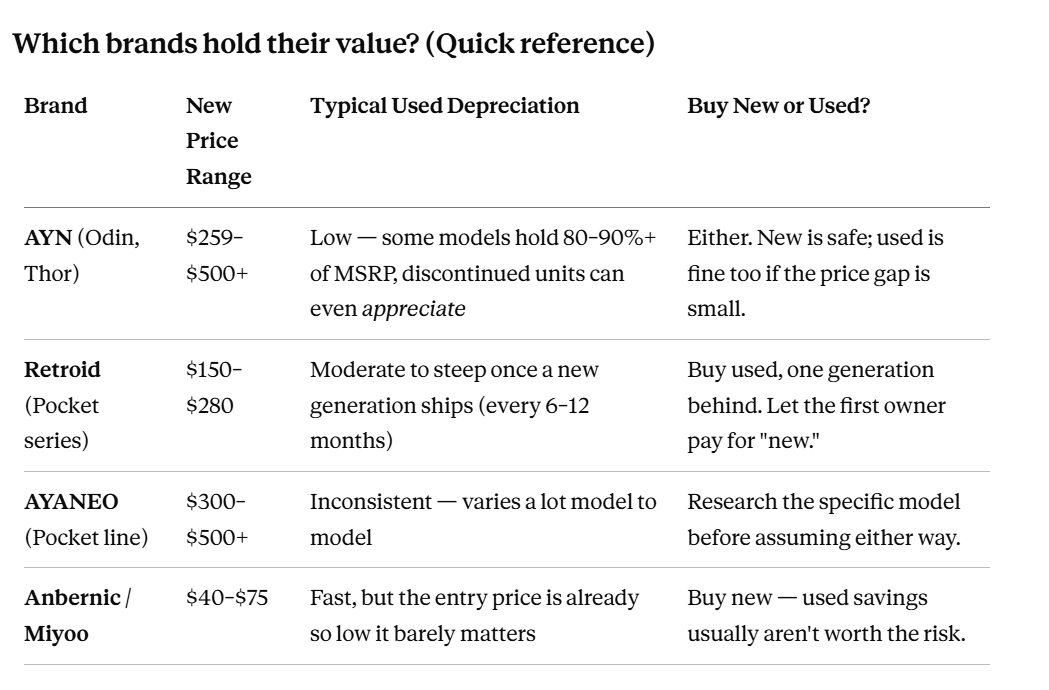
Now let's get into why.
AYN: Buy New and Wait
Verdict: Buy new. The wait is usually worth it.
AYN is one of the strange exceptions in the retro handheld market. Its devices can hold their resale value incredibly well, but unlike brands where scarcity is covering for a mediocre product, AYN has built that demand by making genuinely excellent handhelds. Build quality is consistently among the best I've encountered in this category, the hardware tends to feel more premium than the price suggests, and products like the Odin and Thor series have earned an enormous amount of attention from reviewers and the enthusiast community.
The problem is actually getting one. Read more here about how to get them quick!
AYN frequently launches into huge media and enthusiast hype without having enough readily available inventory to satisfy that demand. Combine limited stock with preorders, direct international fulfillment, and shipping that can take weeks, and suddenly a used AYN handheld that's already sitting in the United States becomes unusually highly valuable. Buyers aren't necessarily paying close to retail because they want a used handheld — they're paying for the ability to get one now.
That's a major reason AYN resale prices can look almost ridiculous. If a brand-new handheld costs only slightly more than a used one but involves waiting weeks for fulfillment, sellers on eBay have very little reason to discount theirs heavily. Sometimes the difference between new and used is so small that it barely feels like depreciation at all.
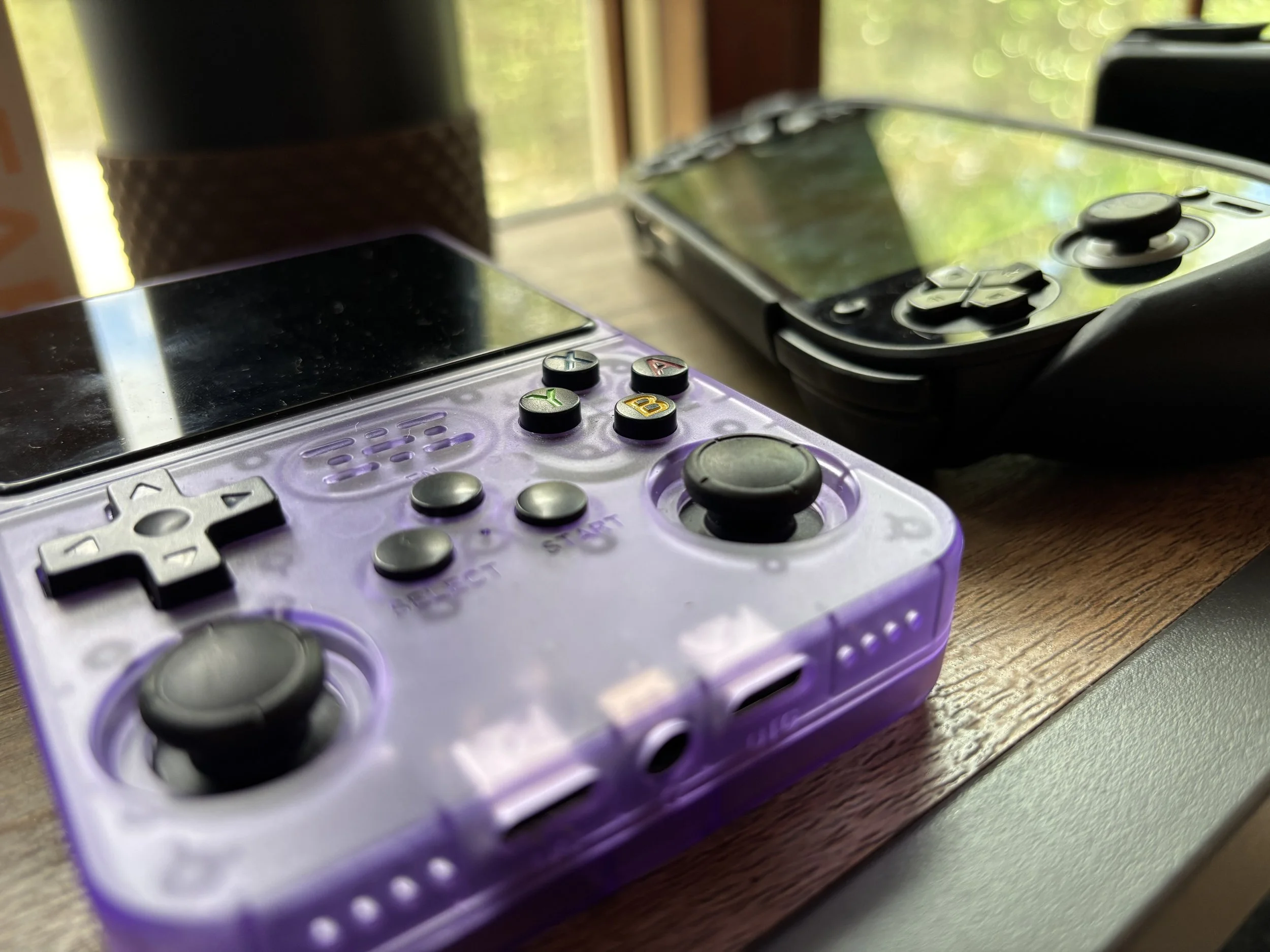
The strong resale market is also helped by the hardware itself. AYN doesn't churn through replacements at quite the same pace as some competitors, and its better handhelds tend to remain desirable well after launch. Powerful chipsets, excellent displays, great controls, and genuinely premium construction mean an Odin doesn't suddenly become irrelevant just because something newer exists.
That's why I wouldn't use AYN's strong resale value as an argument for buying used. I'd use it as an argument for doing the opposite. My Odin 2 Portal cost $310 shipped, used in the USA they are far more than that.
If a used AYN handheld is selling for anywhere close to the direct price, buy it new and wait. You get a brand-new device, you know its history, and you're not paying an artificial premium simply because somebody else already waited for international shipping.
The upside is that if you eventually decide to sell it, you're buying into one of the stronger resale markets in the retro handheld category.
The takeaway: AYN makes some of the best-built and most desirable Android handhelds on the market, and limited availability, slow shipping, and enormous enthusiast hype help keep used prices unusually high. Unless you find a genuinely great secondhand deal, buy direct, accept the wait, and let the strong resale value work in your favor when you're eventually the seller.
Retroid: let the first owner pay for "new"
Verdict: Buy one generation behind, used.
Retroid runs on the opposite model from AYN: fast fulfillment, aggressive pricing, and — this is the important part — a genuinely rapid release cadence. By mid-2026, Retroid had already moved well past the Pocket 4 Pro I own, shipping the Pocket 5(also got one on ebay), the Pocket 6, and the Pocket Nova, a $229 4:3-screened handheld aimed at a different niche entirely. That's three generations of hardware in a category that used to see one release a year.
That pace is great for buyers, and rough for resale. When a new Retroid ships every few months at a similar or lower price point with better specs, the previous generation doesn't have scarcity working in its favor the way an AYN unit does — there's no shipping delay to bridge, and there's always a newer, cheaper-feeling "current" model sitting right next to it in search results. The practical result: Retroid units depreciate faster once their successor lands, which is exactly the gap a used buyer should be exploiting.
This is where my own Pocket 4 Pro purchase is useful firsthand evidence rather than theory. I bought it on eBay well after the Pocket 5 had shipped, at a meaningful discount to what it cost new — and functionally, for anything up to PS2-era emulation, it does the same job a current-gen Retroid does. The lesson isn't "Retroid is a bad brand." It's "don't be the one who pays full retail for the newest Retroid the week it ships, because the resale curve is going to punish that decision within a year."
The takeaway: If you want a Retroid, buy used and buy one generation behind on purpose. Let someone else's "gotta have the newest one" pay for the depreciation you'll skip. AYN vs Retroid? Still can’t decide, read more here!
AYANEO: depends entirely on the model — don't generalize
Verdict: Research the specific unit. Don't assume the brand behaves consistently.
AYANEO is the hardest brand to make a blanket call on, because it ships an unusually high number of distinct models — Pocket DMG, Pocket ACE, Pocket AIR, Pocket S2, Pocket Micro, plus full-size Ryzen-based devices — often within the same year, and resale behavior doesn't move together across all of them. Some models are harder to get, some are easy.
Take two Pocket-line models with similar specs: a used Pocket DMG (16GB/512GB) has sold for around $415, while a used Pocket ACE (16GB/512GB) has sold for around $360, and current asking prices for lower-spec Pocket ACE units (8GB/128GB) run close to $430 pre-owned on eBay — sometimes barely under what similar configurations cost new. That's not a consistent depreciation curve; it's two different products behaving two different ways, likely driven by factors specific to each model (color/finish desirability, whether it's still in production, how enthusiast communities feel about that specific chipset).
I'd genuinely caution against reading too much into a handful of data points here — this is exactly the kind of category where you need a larger sample of sold listings before declaring "AYANEO holds value" or "AYANEO depreciates badly." What the evidence does support is that AYANEO's rapid model turnover — several new SKUs per year — makes it structurally more likely to behave like Retroid (newer model undercuts the old one) than like AYN (scarcity holds price up). But which specific model you're looking at matters more than the brand name on the box.
The takeaway: Before buying AYANEO new or used, check sold listings for that exact model and configuration — not just the brand. The variance is too high to generalize.
Anbernic and Miyoo: just buy new
Verdict: Skip the used market. It's not worth the risk.
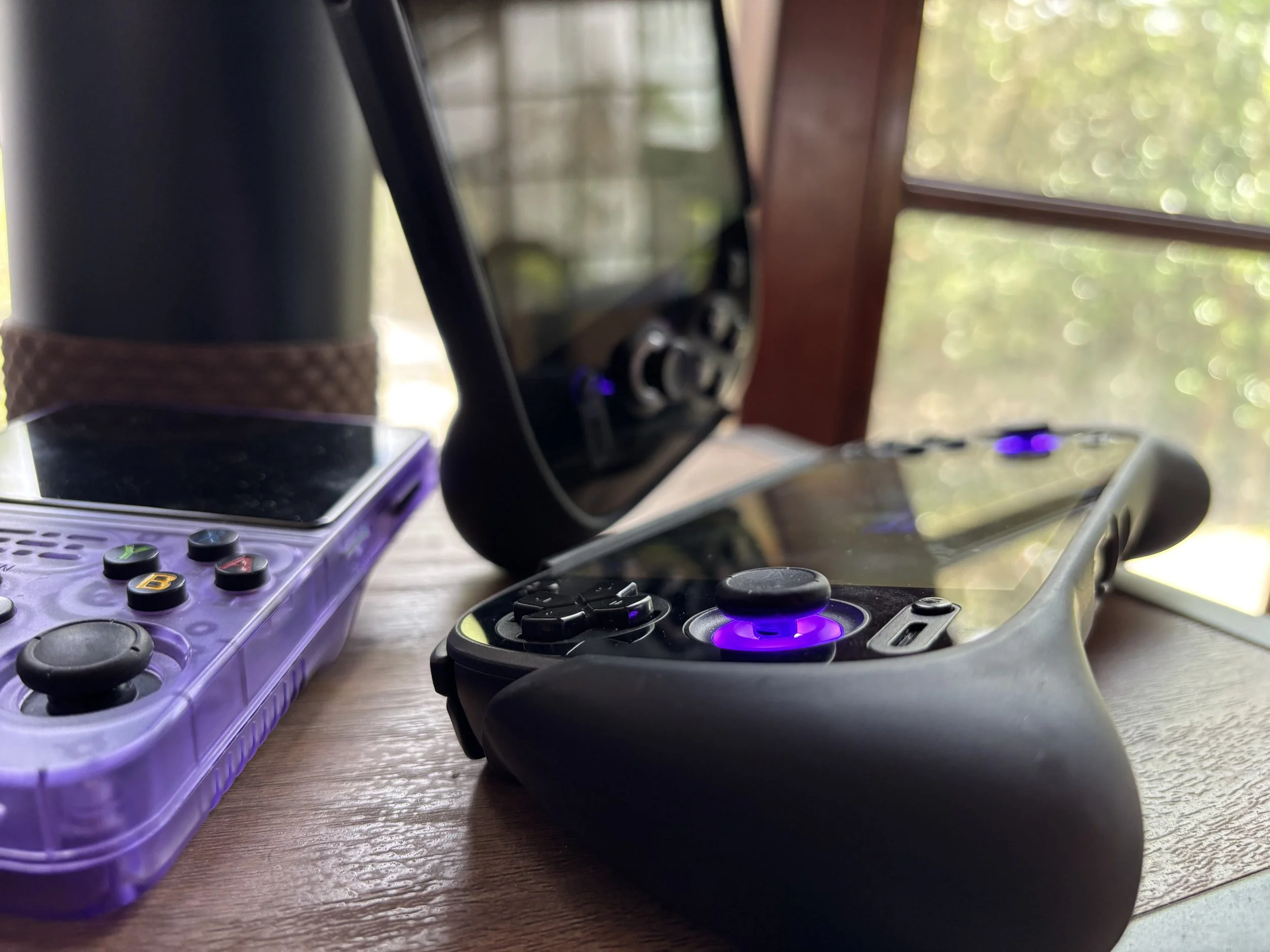
This tier plays by completely different rules because the starting price is already so low. Anbernic's RG35XX line launched at $55, with variants like the RG35XX SP running $58.99–$73.99 depending on storage, and it's not unusual to see brand-new units discounted to $42 during sales. The Miyoo Mini Plus sits in the same rough $50 territory. When the new price is already that close to disposable-income territory, a "used" unit selling for $10–$15 less isn't much of a deal once you factor in shipping, the lack of warranty, and the risk of a worn D-pad or a battery that's already degraded from a year of daily use.
There's also a volume factor: Anbernic and Miyoo release new models constantly, and the used market gets flooded fast — which should, in theory, push prices down further. It doesn't push them down proportionally, though, because the floor is already so low that marketplace fees and shipping start to eat most of the potential savings. A seller shipping a $45 handheld often can't price it much below $30 and still make the listing worth their time.
The takeaway: Unless you're getting a genuinely steep, obviously-good deal, buy these new. The used discount usually isn't big enough to offset the condition risk.
You can also get most models on Amazon so speed is not as big of an issue.
The factors that actually drive resale value
If you remember nothing else from the brand breakdowns, remember these — they're the reason the patterns above exist, and they'll still apply to whatever brand releases next year.
Fulfillment speed. This is the big one. Slow overseas shipping on a new unit makes a used, already-in-hand unit worth a premium. As manufacturers speed up fulfillment (which AYN has been gradually doing), expect this advantage to shrink over time.
Release cadence. Brands that ship a new generation every few months (Retroid, increasingly AYANEO) create constant downward pressure on the previous model. Brands that release less often (AYN) let existing units hold their ground longer.
Scarcity and discontinuation. A device going out of production doesn't automatically tank its value — sometimes it does the opposite, especially for a well-regarded model in a limited configuration or colorway.
Condition and accessories. Original box, cables, case, and screen protector applied from day one all matter more in this hobbyist market than in general consumer electronics resale, because buyers are often collectors as much as users.
Chipset longevity. A device built on a chipset that's still relevant for emulation (strong PS2/GameCube performance, for example) ages better than one that was already near its performance ceiling at launch.
Storage configuration. Higher RAM/storage variants tend to hold value better in absolute dollars, but not necessarily better as a percentage of what you paid — the DMG vs. ACE comparison above is a good example of two similar specs behaving differently.
What this actually means if you're buying
Considering an AYN handheld at $300–$500? The depreciation risk is lower than it looks — if you don't love it, you can likely resell for most of what you paid. That should make the purchase decision easier, not harder.
Eyeing a Retroid? Don't buy the newest one at full price unless you specifically want the latest hardware(Hint, you probably don’t need it, my pocket 4 pro plays everything I want it to). Let the first owner absorb the drop and buy used, one or two generations back — you'll get nearly the same experience for meaningfully less. And this is why I got into retro handheld gaming, read more here to find out why!
Looking at AYANEO? Don't assume last year's flagship will hold anywhere near what you paid. Check sold prices for that exact model before you buy, new or used.
Just want something cheap to try emulation? Buy an Anbernic or Miyoo new. At this price point, resale isn't the game — value is.
New vs. eBay: a quick gut check
If you're trying to decide between a manufacturer's direct store and eBay for any of these brands, the shipping-speed factor above is your best guide: the slower the manufacturer's own fulfillment, the more a used, already-stateside unit is worth paying extra for. I bought my AYN unit direct and my Retroid Pocket 4 Pro used on eBay, and both were the right call for the respective brand — not because one channel is universally better, but because the two brands sit on opposite ends of the fulfillment-speed spectrum that drives this whole market. So check around first and have fun! Got an R36S Handheld and want to upgrade? Keep reading here!