I've Repaired Hundreds of Lightning-Damaged Home Theaters—Here's What Every Homeowner Gets Wrong
Disclosure: We may earn a commission when you purchase through links on our site. This does not influence our reviews or recommendations.
Every summer in Central Florida, I get the same call: "Lightning hit the house, and now the TV won't turn on."
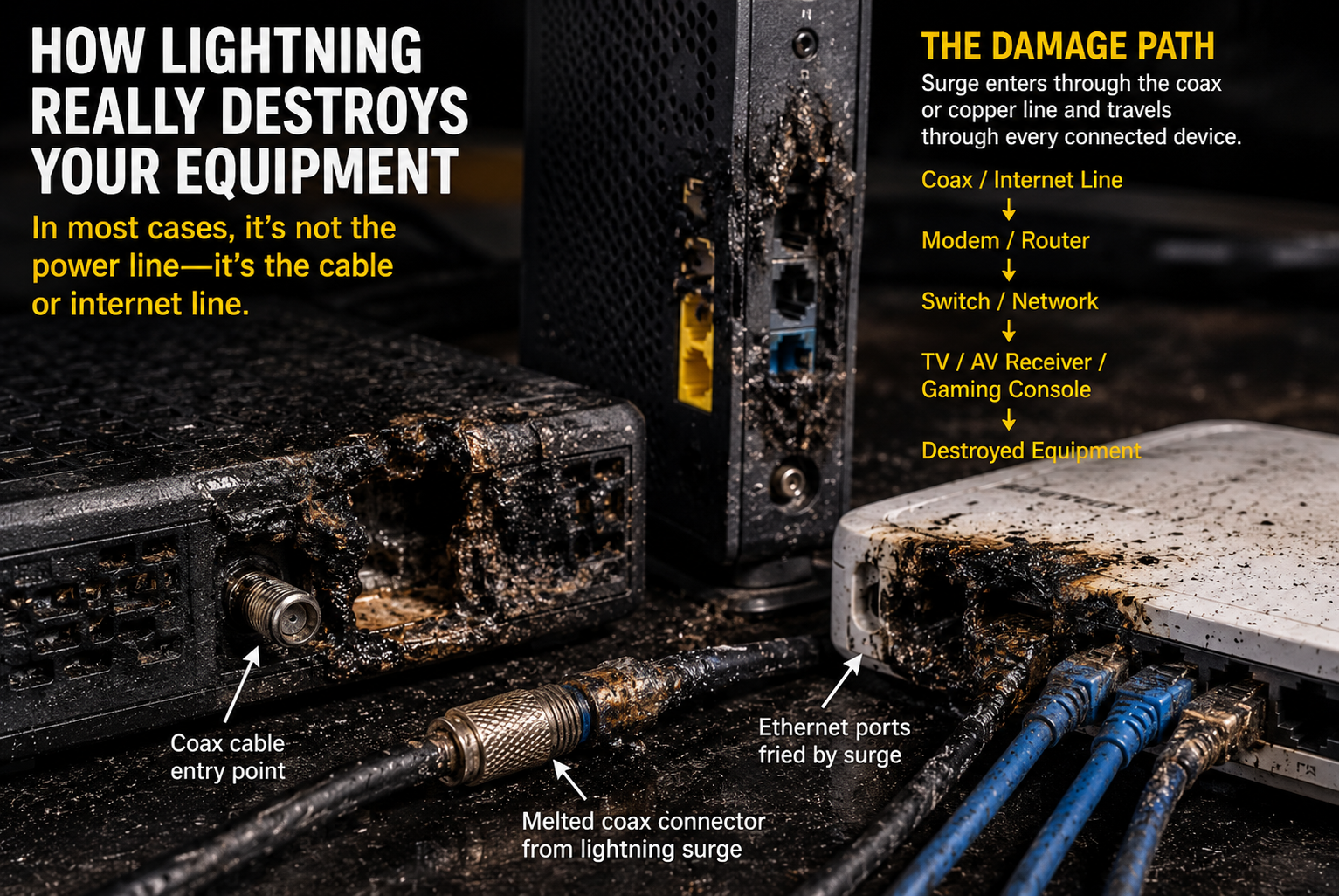
After over a decade in low-voltage and home theater installation, I've worked hundreds of lightning and surge cases. The pattern is consistent: roughly 90% of the damage I see doesn't come through the electrical outlet. It comes through the cable or internet line.
The Biggest Myth About Lightning Damage
People picture a strike surging through the grid and blowing out every outlet in the house. It happens, but it's rare. Far more often, the surge rides in through coax, copper internet lines, or phone wiring straight into connected equipment. That's why I'll walk into a house and find the modem, router, cable box, TV, and AV receiver all fried — while the fridge, the microwave, and everything else on the electrical panel is fine.
Why Cable and Internet Lines Are So Vulnerable
Power lines have layers of protection built in before electricity ever reaches your home. Cable and internet lines mostly don't. Coax and copper Ethernet act like a direct highway for surge energy into sensitive electronics, and once it's in, it spreads: modem to router, router to switch, switch to TV, TV to receiver, receiver to your gaming console or camera system. One strike, one path, and you can lose thousands in electronics in seconds.
Fiber Changes the Game
The biggest improvement I've seen in my career is the shift to fiber internet. Fiber runs on glass and carries data as light, not electricity, so it doesn't give lightning a conductive path into your network gear the way copper does. It won't make your house immune, but it eliminates one of the most common entry points I deal with. 100% worth it for that alone, not just the speed.
Surge Protectors Help — They're Not Magic
Good surge protection matters. I've had great results over the years with SurgeX and Furman — real, professional-grade gear that cuts down risk from everyday power events. But no surge protector guarantees protection from a direct or powerful strike. Enough energy hits, something gives eventually.
The Only 100% Protection
If you want guaranteed protection in a serious storm, unplug your gear — power and incoming communication lines both. Not a surge protector, not a UPS, not a whole-home conditioner. Physically disconnecting is the only method I've ever fully trusted. It's a pain. It also works every time.
Don't Count on Surge Protection Warranties
Plenty of surge protector companies advertise big equipment-protection guarantees. I've had clients try to file those claims. I've never once seen one actually pay out. The documentation, inspections, and proof-of-installation hoops make it nearly impossible to collect. Buy quality surge protection because it's good protection — not because of the warranty behind it.
When Insurance Actually Pays
The claims I've actually seen succeed are homeowners insurance claims, and only when the damage gets big — AC units, major appliances, multiple TVs, a whole home theater system wiped out. Once the loss clears the deductible and falls under the policy, homeowners insurance is what actually comes through.
Our Take
In Florida, lightning isn't a matter of if — it's when. You can't eliminate the risk, but you can cut it down. Run quality surge protection. Don't ignore your cable and internet lines. And if a serious storm is rolling in and you want real peace of mind — unplug everything.