
Disclosure: We may earn a commission when you purchase through links on our site. This does not influence our reviews or recommendations.
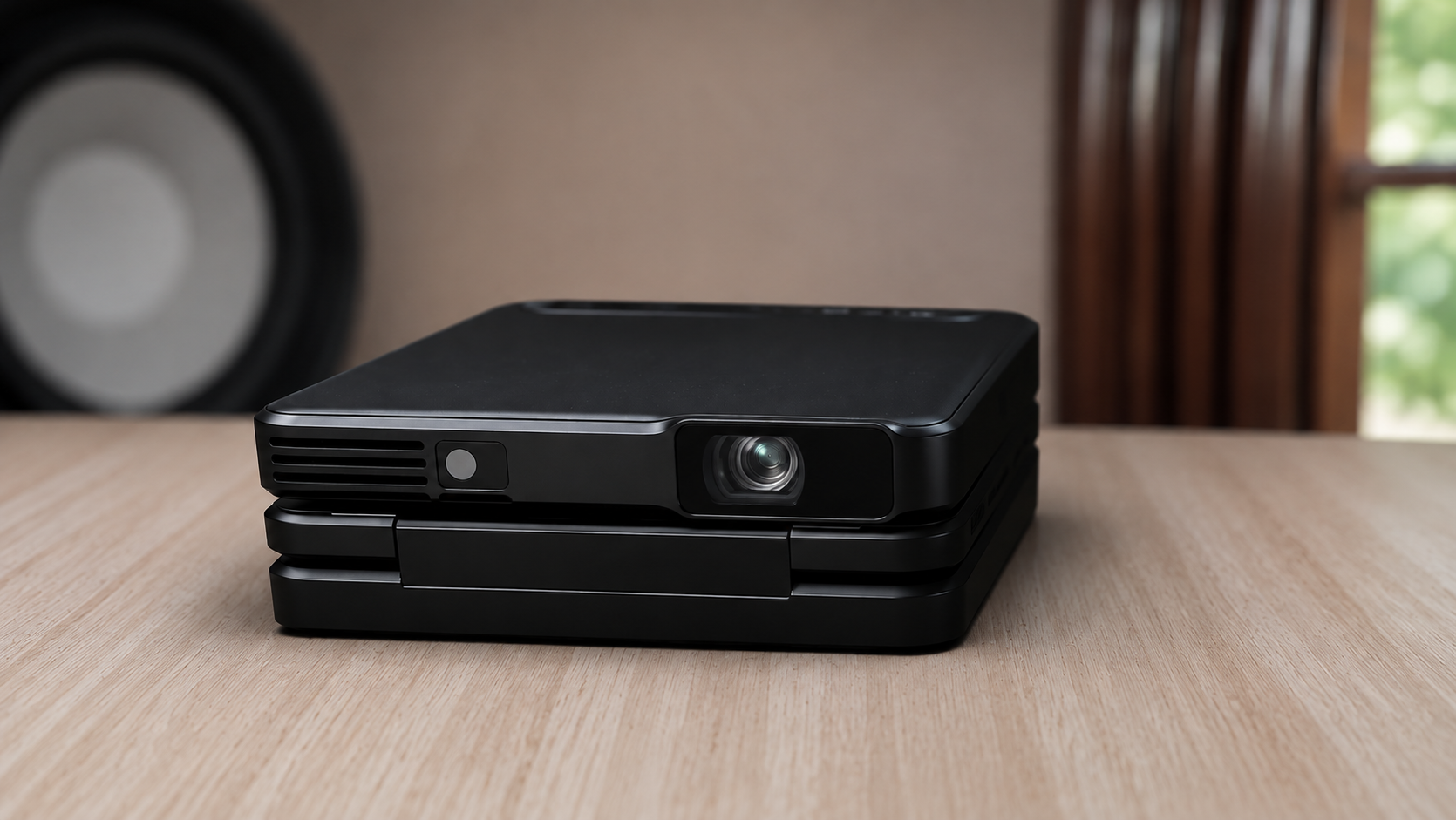
Portable projectors aren't all portable in the same way. Some are small enough to toss in a bag and take practically anywhere, while others are better for movie nights at home. Aurzen has options for both, but choosing between them involves more than comparing brightness and resolution. We're taking a look at three of its projectors: the ZIP, EAZZE D1R air and BOOM mini. Each handles portability, streaming and picture quality differently, and those differences are important once you know where you'll actually use them.
Aurzen ZIP: A Projector That Fits in Your Pocket
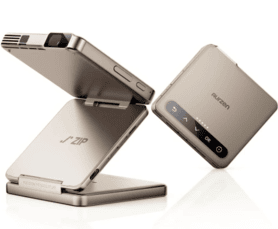
Best for: Travel and quick viewing sessions
The ZIP folds into three sections instead of using a traditional rectangular body, and it weighs just 280 grams (about 9.9 ounces). Unfolding it creates an adjustable stand, so you don't have to pack a separate tripod just to aim the picture at a wall. Indiana has also spent some time with the original ZIP and compared it directly with the newer ZIP Pro. It's the only projector of the three with a built-in battery. Aurzen rates its 5,000mAh battery for up to 1.5 hours of playback, which is fine for shorter videos but won't get you through most full-length movies. You can keep watching with a suitable USB-C PD charger, although that means staying near a power source.
The ZIP uses DLP technology with native 720p resolution and a rated brightness of 100 ANSI lumens. You'll want a dark room and a relatively modest image for the best results. Aurzen recommends roughly 40 to 60 inches rather than trying to fill an entire wall. Time-of-flight autofocus and automatic keystone correction help with setup, while the folding design supports both horizontal and vertical viewing. However, keystone correction only works vertically, up to about ±25 degrees, so you'll want to position the projector directly in front of the wall. It also mirrors content from compatible phones, tablets and computers without needing a Wi-Fi network, although certain Google Cast devices, including Pixel phones and Chromebooks, aren't supported. Streaming services like Netflix and Disney+ are another limitation, as copy protection generally prevents ordinary wireless mirroring, and the ZIP doesn't have streaming apps built in. Aurzen sells separate CastPlay accessories for protected streaming content, but they're an additional purchase.
Audio is limited to dual 1W speakers, although Bluetooth 5.4 lets you connect headphones or an external speaker. The ZIP suits travel and short sessions, but for regularly streaming full movies, the other two are easier to work with.
Aurzen EAZZE D1R air: Roku TV You Can Move Around
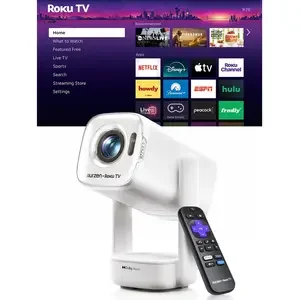
Best for: Streaming in different rooms or occasional outdoor movie nights
The EAZZE D1R air takes a more conventional approach, with Roku TV built in. Once you've connected it to Wi-Fi and activated Roku with an account, you can open apps such as Netflix, Prime Video, Disney+, Hulu and YouTube using the included remote or Roku's mobile app. There's no need to mirror your phone just to start a show. It also offers native 1080p resolution and a higher rated brightness of 300 ANSI lumens. You'll still want a dim room or a properly dark backyard, though. Aurzen advertises image sizes from 40 to 150 inches but recommends staying around 80 inches or smaller for better results. Its adjustable stand makes wall or ceiling projection easier, while time-of-flight autofocus and automatic keystone correction handle much of the picture adjustment.
The dual 5W speakers support Dolby Audio, while Bluetooth and a 3.5mm audio output let you connect your own speakers or headphones. HDMI and USB ports are also available for devices such as game consoles. And while the D1R air doesn't have an internal battery, it can run from a compatible USB-C power bank supplying at least 65W through USB-C Power Delivery at 20V. Not every power bank meets that requirement, and one isn't included, so check the specifications before planning a movie night away from an outlet. With streaming apps and a sharper picture than the ZIP, plus the ability to run from an external power bank, the D1R air gives you more options for moving between rooms or setting up outside.
Buy the Aurzen EAZZE D1R air on Amazon
Aurzen BOOM mini: More Room for Movie Night
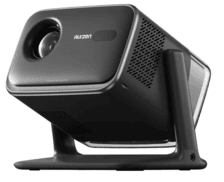
Best for: Home streaming and stronger built-in audio
The BOOM mini is better suited to a bedroom or living-room movie setup. It isn't nearly as small as the ZIP, but it has the highest manufacturer-rated brightness of these three models, at 500 ANSI lumens, along with native 1080p resolution. That makes it better equipped for larger images, though you'll still get the best results with the lights down. It uses LCD projection and accepts 4K input, but it still projects at 1080p. Google TV is built in, so Netflix, YouTube, Disney+ and Hulu are available without a separate streaming device. The mini also has dual 10W speakers with Dolby Audio and Aurzen's VibeBass processing. Rated speaker output doesn't guarantee sound quality in your room, but that's a clear increase over the D1R air's dual 5W speakers and the ZIP's dual 1W speakers. Connections include dual-band Wi-Fi, Bluetooth 5.1, one HDMI input, two USB ports and a 3.5mm audio output.
Its stand adjusts through 110 degrees, and real-time autofocus and keystone correction make it easier to move the picture from a wall to the ceiling. But despite the name, the BOOM mini isn't especially tiny. It weighs about 4.7 pounds, measures roughly 9.1 inches across and needs an AC outlet because there's no built-in battery. You can move it between rooms, but it's more of a portable home projector than something you'd carry everywhere. For regular movie nights at home, the added brightness and speaker power are the main attractions.
Buy the Aurzen BOOM mini on Amazon
Which Aurzen Projector Should You Choose?
Where you plan to use your projector is the deciding factor. The ZIP is the easiest to pack and the only one here that runs on its own battery, but its dimmer 720p image and screen-mirroring limitations make it better for short, casual viewing sessions. The D1R air offers a more familiar streaming experience with Roku TV, native 1080p and the option of using a compatible power bank when you're away from an outlet.
The BOOM mini is better suited to a regular movie-night setup. Its higher rated brightness, Google TV and dual 10W speakers give it an advantage for home entertainment, even if you'll need to plug it in and find a little more room for it. None of these projectors is designed to compete with a bright television in full daylight, so lighting conditions will still play a big part in the viewing experience.
Before You Buy a Portable Projector
Aurzen rates these models at 100, 300 and 500 ANSI lumens respectively, which helps explain why they suit different spaces. But projecting a larger image spreads the available light over more area, so the biggest advertised screen size won't necessarily give you the best results. A smooth, light-colored wall can work for casual viewing, while a proper screen provides a more consistent surface.
You will also need enough distance between the projector and the wall to get the image size you want. The required distance varies by model, and an adjustable stand isn’t going to solve every placement problem. Some viewers also notice brief rainbow-like flashes with certain DLP projectors, though the effect varies by model and person. If you're sensitive to it, seeing a projector in person or checking the return policy can help.
Power and streaming are the other major considerations. The ZIP can run on its own battery but relies on compatible mirroring or an additional accessory for protected streaming content. The D1R air and BOOM mini have streaming platforms built in, but streaming apps require an internet connection. And while the D1R air can run from a suitable USB-C power bank, the BOOM mini needs an AC outlet.
